Find the best areas to stay in Las Vegas based on your travel style, budget, trip length, and how you want to use the city. In Vegas, your hotel is part of the itinerary: it decides how much you walk, how often you need rideshare, how easy show nights feel, whether pool time actually works, and whether the Strip feels exciting or exhausting. The smartest choice is not always the cheapest room or the most famous resort, but the base that protects your time, energy, and evening plans.
Best areas
Central Strip is the strongest first-time and short-stay base; South Strip is better for family, pool, value, airport-side, and larger-resort logic; Downtown suits nightlife and old-Vegas repeat visits; North Strip works for selected luxury or hotel-led stays; Arts District and Chinatown are conscious off-Strip choices for food, bars, local texture, and travelers who already know they do not need classic Strip walkability.
Booking timing
Book early for major conventions, fight weekends, F1 and arena events, holiday periods, spring and autumn weekends, and any premium central hotel. Always compare the all-in rate after resort fees, parking, and expected transport costs, not just the headline room price.
Best areas to stay in Las Vegas at a glance
Central Strip – Best for: first-time visitors, short stays, shows, dining, and classic Vegas landmarks · Vibe: high-intensity, central, walkable by Vegas standards, and visually loaded · Stay here if: you want the easiest access to Bellagio, major resorts, flagship restaurants, views, shows, and late-night movement without repeated rides · Avoid if: you want calm, local texture, lower all-in costs, or a hotel stay built mainly around quiet recovery
South Strip – Best for: families, pool time, better-value resorts, airport-side logistics, and longer stays · Vibe: larger-scale, practical, resort-led, and less compressed than the center · Stay here if: you want space, pool infrastructure, family-friendly resort logic, or a slightly better room-to-price trade-off while staying in the Strip ecosystem · Avoid if: you expect to drift on foot between the central icons several times a day
Downtown Las Vegas – Best for: nightlife, Fremont energy, old Vegas, value, and adult-focused repeat trips · Vibe: denser, louder, less polished, more compact, and more social after dark · Stay here if: you want bar-hopping, Fremont Street, older casino character, Mob Museum / Neon Museum access, and a different Vegas rhythm · Avoid if: you want polished luxury resorts, pool-led days, or classic central Strip landmarks outside the hotel door
North Strip – Best for: selected luxury properties, convention logic, larger resorts, and hotel-led repeat stays · Vibe: big-property, more spaced-out, less central, sometimes more composed · Stay here if: the specific hotel is the draw, you are comfortable using taxis or rideshare, or you want a major resort with more breathing room · Avoid if: your first trip depends on casual walking between Bellagio, Caesars, Venetian, and other central landmarks
Arts District – Best for: return visitors, local texture, bars, breweries, restaurants, and calmer off-Strip evenings · Vibe: creative, lower-rise, social, food-led, and less resort-managed · Stay here if: you want a consciously different Las Vegas base with murals, cocktail bars, breweries, and easy Downtown / Strip rides · Avoid if: you want pools, giant resort amenities, or a classic first-time hotel experience
Chinatown – Best for: food-driven repeat visitors, longer stays, off-Strip dining, and rideshare-based trips · Vibe: functional, corridor-based, local, restaurant-led, and practical rather than scenic · Stay here if: Spring Mountain Road dining, Thai, Korean, Japanese, Chinese, and off-Strip food are central to the trip · Avoid if: you want to walk from the hotel to headline landmarks or stay somewhere visually iconic
How to choose the right area in Las Vegas
In Las Vegas, the best area is the one that matches the real shape of your days and nights. A cheap room can become poor value once resort fees, parking, rideshare, long internal walks, late-night fatigue, and heat are added back in. A premium central hotel can be worth it on a two-night first trip, while a larger South Strip resort, Downtown base, or off-Strip food corridor can make more sense once the trip becomes longer, slower, more local, or more repeat-visitor led.
For a first trip of two or three nights, pay for location before paying for room category.
Compare total stay cost after resort fees, parking, and transport, not only the headline nightly rate.
Central Strip is the default when shows, dinners, fountains, views, and classic landmarks define the stay.
South Strip is often smarter for families, pool-led stays, road-trip combinations, and travelers who need more room or calmer resort logic.
Downtown is not a cheaper version of the Strip; it is a different nightlife and old-Vegas base, best chosen deliberately.
North Strip can be excellent when the hotel is the point, but weak if you expect easy first-time walking to the central icons.
Arts District and Chinatown are good bases only when food, bars, murals, or off-Strip rhythm are part of the trip identity.
In summer, shade, pool access, internal resort comfort, and short transfers matter more than they do in spring or autumn.
Families should judge hotels by pool quality, room layout, internal convenience, and transfer simplicity rather than the most famous address.
For groups, a slightly less central hotel can work if everyone accepts ride-hailing, but it fails quickly when people want different schedules.
For luxury stays, location still matters: a better room in a disconnected area may underperform a slightly less impressive central property.
On longer stays, a calmer hotel and better food access can matter more than sleeping at the exact center of the Strip every night.
Las Vegas geography from a stay perspective
Las Vegas is not one hotel corridor. The Strip alone behaves like several separate bases, Downtown is a distinct nightlife and museum geography, and Arts District and Chinatown only work when the trip is intentionally off-Strip. Resort scale distorts distance: a hotel can look close on a map but still require pedestrian bridges, casino interiors, long driveways, heat exposure, or rideshare queues. Choosing where to stay is really choosing which energy band you want closest to your room.
Central Strip and South Strip are both on Las Vegas Boulevard, but they create very different trip rhythms.
Downtown is a separate evening geography, not a less expensive extension of the Strip.
North Strip can be excellent as a hotel-led choice and weak as a walking-led first-trip base.
Arts District and Chinatown are legitimate bases only when local bars, food, or off-Strip texture are intentional.
Being near a famous hotel does not guarantee easy movement; entrances, casino floors, and bridges reshape short distances.
Summer heat makes bad hotel positioning more expensive in energy, not just in money.
A hotel’s ride-hailing pickup point and parking logic can matter as much as its address.
For shows and sports, staying near the place where the night ends is often smarter than staying near where the day begins.
Hyper-central Strip – Best for first-time stays, headline landmarks, and evenings built around walking, shows, and dinner reservations.
South Strip resort cluster – Better for larger-resort value, family logic, pool-heavy days, and travelers who do not need to be in the middle every hour.
Downtown nightlife cluster – Best for Fremont density, old-Vegas energy, and repeat visitors who want faster evening movement.
North Strip larger-property cluster – Works for selected resort stays and longer or more hotel-led trips, but is weaker for short first visits on foot.
Arts District local-texture cluster – Best for return trips that prioritize bars, food, and a lower-rise local rhythm over resort convenience.
Chinatown off-Strip food cluster – Best for travelers whose hotel logic is built around dining depth and repeated short rides rather than walkability.
Event and arena geography – T-Mobile Arena, Allegiant Stadium, Sphere, convention venues, and major concert calendars can temporarily change which area is the smartest base.
Pool-and-recovery geography – In summer or on longer stays, the best base may be the hotel with the most usable pool, room, and recovery setup rather than the absolute most central address.
Best areas to stay in Las Vegas
These are the Las Vegas areas that make the strongest hotel bases for most travelers. Each one changes the trip in a concrete way: what becomes walkable, how late the city remains easy to use, how often you need rides, and how much friction you absorb between your room and the experiences you actually came for.
Central Strip
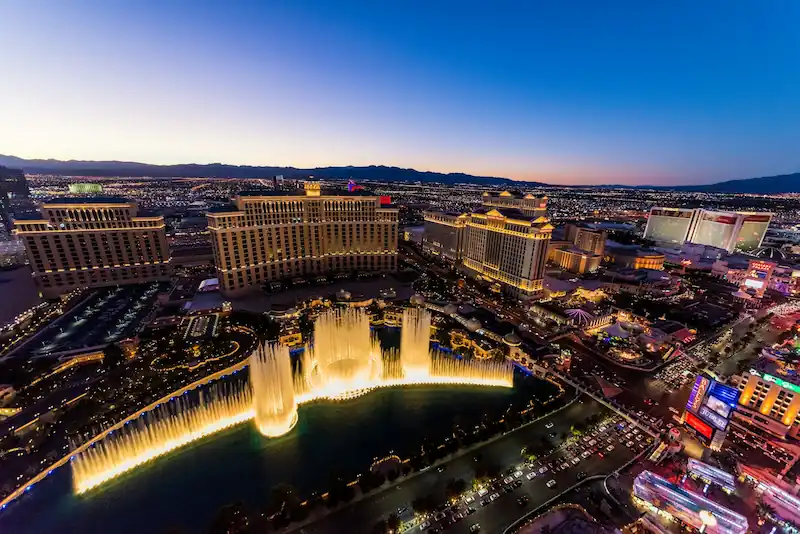
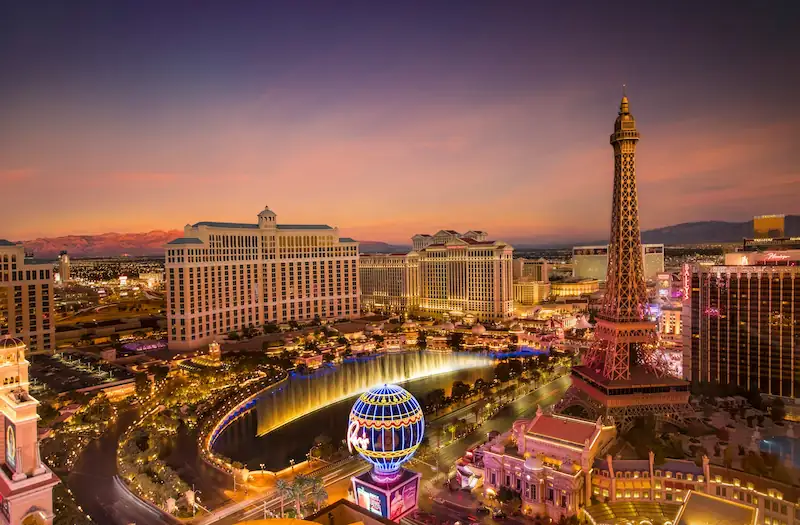
Central Strip is the most efficient base for a first Las Vegas trip because it keeps the city’s core spectacle, flagship resorts, major restaurants, fountains, observation options, and late-night movement within the smallest practical radius. This is where Vegas feels most recognizably itself: giant hotel facades, long casino corridors, choreographed water, pedestrian bridges, shopping passages, and staged momentum. It is also the most stimulating and often the most expensive area once resort fees and demand are added back in. For a short stay, though, that premium often buys the one thing travelers most underestimate in Las Vegas: usable time.
Why stay here: Stay here when you want the cleanest first-time answer, the easiest show and dinner logistics, and the fewest routing mistakes. It is the strongest base for 2- to 4-night trips built around classic Vegas rather than off-Strip exploration.
Best for: First-timers, 2- to 4-night stays, show-led trips, short premium stays, and travelers who do not want to waste time crossing the Strip
Pros
Best walkable access to the classic Strip core
Strongest base for short stays and first-time visitors
Easier dinner and show logistics with less transport dependence
High concentration of recognizable resort landmarks
Good choice if you want the city at full intensity
Best answer when your evenings matter more than room size
Best base for Bellagio, Caesars, Venetian / Palazzo, LINQ, and central Strip sequencing
Reduces late-night rides after shows, dinners, and views
Best area when the hotel location is expected to carry the trip
Cons
Higher total trip cost once fees and central demand are factored in
Constant foot traffic and noise
Hotels can feel crowded and check-in flows can be slow
Less useful if you want a quieter, more local-feeling base
Can feel exhausting on longer stays if you do not build in recovery time
Resort fees and central-demand pricing can make value look worse than the headline rate
Not ideal for travelers who need genuine quiet or a neighborhood feel
Long internal resort walks can still make adjacent places feel slower than expected
Nearby highlights
Walkable access to the Bellagio fountains and the most recognizable central Strip moments
Easier evening dining without committing to repeated ride-hailing
Better positioning for one-show nights that end late
Quick access to major casino-resort interiors worth reading as part of the city itself
Practical reach to the LINQ Promenade and central restaurant density
Stronger late-night flexibility when you do not want to be far from your room
Best positioning for travelers who want to keep Las Vegas visually and socially intense
Best access to Bellagio Conservatory and central free sights
Good base for Sphere or major show nights when combined with a short ride
Strongest area for visitors who want one evening to remain spontaneous
Budget
The LINQ Hotel & Casino – A central-value option with one of the most useful mid-Strip positions for short stays. Why we recommend: One of the few more affordable central Strip stays where the location meaningfully compensates for the compromises. Check availability
Flamingo Las Vegas Hotel & Casino – Classic Strip address with practical access to central landmarks and a broad on-site setup. Why we recommend: You are paying for one of the most usable locations in the city rather than a refined hotel product. Check availability
Harrah's Las Vegas – A straightforward Caesars option that keeps you in the middle of the action without Bellagio-level pricing. Why we recommend: It often makes sense for travelers who want central Strip access without paying for full upscale positioning. Check availability
Mid
Paris Las Vegas Hotel & Casino – A central resort stay with stronger atmosphere and more visual identity than many similarly placed options. Why we recommend: It gives you a more memorable central Strip base without immediately jumping into top-tier luxury pricing. Check availability
Planet Hollywood Resort & Casino – Lively, central, and well suited to travelers who want restaurants, shopping, and easy late-night movement. Why we recommend: The positioning works especially well if your trip is built around evening energy more than hotel serenity. Check availability
Horseshoe Las Vegas – A pragmatic central base with large-room logic and solid access to the busiest part of the Strip. Why we recommend: It can be a smarter pick than flashier neighbors when room function and location matter more than image. Check availability
Upscale
Bellagio – A classic luxury Strip stay with immediate access to one of the city's most iconic central addresses. Why we recommend: Its location and sense of arrival still make it one of the cleanest premium answers for a first Vegas trip. Check availability
The Cosmopolitan Of Las Vegas – A more contemporary luxury option with stronger design character and a social edge in the center of the Strip. Why we recommend: It suits travelers who want centrality without a conventional old-guard resort feel. Check availability
Caesars Palace Hotel & Casino – Large-scale classic Vegas luxury with deep on-site infrastructure and high-profile central positioning. Why we recommend: Few hotels combine central access and full-scale resort gravity as effectively for a short premium stay. Check availability
South Strip
South Strip is the most practical Strip choice when the trip needs room space, pool time, family rhythm, airport-side access, or stronger value more than constant central walking. It still gives you a real Las Vegas resort stay, but the boulevard feels broader and less compressed than the middle of the Strip. This can be a strength for families, longer stays, and travelers who plan to use taxis or rideshare anyway. The key is accepting that it is not the same as staying in the central spectacle zone: if your night repeatedly ends around Bellagio, Caesars, or Venetian, transport becomes part of the stay.
Why stay here: Choose South Strip when resort function, pool infrastructure, room comfort, and value matter more than sleeping in the visual center. It is often the best compromise for families and longer stays that still want a Strip address.
Best for: Families, larger-resort stays, pool-heavy trips, better-value first visits, slower-paced stays, and travelers arriving by car
Pros
Often stronger room-size and resort-value trade-offs than the central Strip
Good fit for families and slower-paced travelers
Easier arrival logic from the airport side of the city
Several big-resort options that work well for pool-led stays
More practical than glamorous for travelers who do not need full centrality
Stronger fit for longer stays where room comfort matters more
Good fit for Mandalay Bay, MGM, airport-side arrivals, and stadium-related plans
Often better for travelers with a car or road-trip segment
Can feel less relentless than Central Strip over several nights
Cons
Longer walks to the most iconic central Strip anchors
Casual back-and-forth movement on foot becomes tiring fast
Some stays here feel more transport-dependent than they first appear
Less immediate nighttime atmosphere outside the resorts themselves
Can feel too far from the visual heart of Vegas on a very short trip
Central Strip evenings require more planning and ride-hailing
Some properties feel self-contained rather than walkable to the city’s strongest sights
Not the best choice for a very short first-time, show-heavy weekend
Nearby highlights
Good access to larger resort facilities that can carry a full afternoon without leaving the property
Easier family pool logic than many central Strip addresses
Useful for combining Allegiant Stadium logic, airport convenience, and Strip access
Stronger room-to-price ratios in several major properties
More practical base for travelers who expect to use taxis or ride-hailing anyway
Simple positioning for split stays that combine Vegas with a road-trip segment
Better fit for travelers who want the Strip without paying for full centrality every night
Useful access to Shark Reef, pools, and family-friendly resort infrastructure
Better base for Allegiant Stadium events than many central hotels
Good option when the stay includes a late arrival or early departure
Budget
Excalibur – A large-scale budget-conscious Strip resort that still keeps you inside the main boulevard experience. Why we recommend: It is one of the clearer value plays for travelers who want the Strip without paying central-luxury rates. Check availability
Luxor – A recognizable South Strip option with oversized resort infrastructure and regular value appeal. Why we recommend: It works when you want a true resort base at a lower entry point than many better-known central addresses. Check availability
Ellis Island Hotel Casino & Brewery – A simpler, value-oriented stay just off the Strip with a more functional feel than the big resorts. Why we recommend: It is one of the few lower-cost options that can still make location sense for cost-conscious travelers. Check availability
Mid
New York-New York – A strong mid-range resort base with better South Strip positioning than some travelers expect. Why we recommend: It balances recognizable Vegas energy with more manageable pricing than many central icons. Check availability
MGM Grand – A major resort with deep amenities, solid transport logic, and enough scale to support a full stay rhythm. Why we recommend: It makes sense for travelers who want a big-resort experience without paying top-tier luxury rates. Check availability
The Signature at MGM Grand - All Suites – All-suite accommodation with a calmer feel than the main MGM floor while staying well connected to the Strip. Why we recommend: It is a smart middle-ground for travelers who want more room and less casino friction at night. Check availability
Upscale
Mandalay Bay – A full-scale premium resort with strong pool appeal and a more self-contained South Strip rhythm. Why we recommend: It is one of the more coherent upscale answers for travelers who want resort time to matter, not just sleep quality. Check availability
ARIA Resort & Casino – A polished upscale base with stronger contemporary design and excellent access to the southern-central Strip transition. Why we recommend: It often feels sharper and more modern than similarly priced classic Vegas resorts. Check availability
Vdara Hotel & Spa at ARIA Las Vegas – A quieter upscale option with a calmer residential-style feel and easy access to the core without living inside it. Why we recommend: It is unusually good for travelers who want comfort and location without a full casino-first environment. Check availability
Downtown Las Vegas
Downtown Las Vegas is the clearest alternative to the Strip for travelers who want old-Vegas texture, Fremont energy, quicker venue-to-venue movement, better-value rooms, and a nightlife base that feels less polished. The area is more compact, louder in a different way, and more socially immediate after dark. It is not the best substitute for a classic first-time Strip trip, but it is one of the strongest choices for repeat visitors, adults-only weekends, bar-hopping, Mob Museum / Neon Museum access, and travelers who want Las Vegas to feel less resort-managed.
Why stay here: Stay Downtown when the point is Fremont, old casino character, dense nightlife, museums, and a different social tempo. It works best when chosen as a style of trip, not merely as a cheaper hotel search result.
Best for: Nightlife-first stays, repeat visitors, adults-only weekend trips, museum-and-bar combinations, and travelers who want Vegas with looser edges
Pros
Stronger nightlife density in a smaller area
More distinct old-Vegas identity than the Strip
Often better value than equivalent central Strip nights
Faster movement between bars, casinos, and late-night food
A good way to keep the city from feeling too resort-managed
Useful positioning for the city's strongest museum layer
Best base for Fremont Street, Fremont East, Mob Museum, and Neon Museum planning
Often easier for spontaneous low-friction evenings than the Strip
Can reduce total cost for adult nightlife trips if the itinerary is Downtown-led
Cons
Not ideal if your priority is the classic first-time Strip experience
Can feel rougher and louder than polished resort zones
Less suited to travelers seeking luxury-brand calm
Some hotel stock feels older or more uneven than Strip favorites
Weaker if you expect repeated central Strip movement
Can be loud, rougher, and less family-friendly late at night
Not the right answer if most plans are central Strip shows and dinners
Hotel quality is more uneven than in the resort corridor
Nearby highlights
Immediate access to Fremont nightlife without repeated rides back to the Strip
Easier late-night movement between casinos, bars, and casual food
Better positioning for the Mob Museum, Neon Museum, and the city's older historical layer
A more compact evening geography that reduces wasted time
Useful access to the Arts District without staying inside the Strip machine
A distinct alternative social tempo for travelers who find the Strip too orchestrated
Stronger identity if your trip is meant to feel different from a pure resort stay
Fast access to Fremont East bars and old casino signage
Good base for a Neon Museum plus Downtown night combination
Practical for travelers who want more museum depth without Strip transfers
Budget
Four Queens Hotel and Casino – A straightforward Fremont option with unusually strong value logic for the location. Why we recommend: The lack of resort-fee pain makes it more competitive than many travelers expect in this part of town. Check availability
Oasis at Gold Spike – A lower-cost Downtown stay with a younger, looser feel and easy Fremont access. Why we recommend: It works best for travelers who want Downtown energy without paying for a larger casino resort. Check availability
El Cortez Hotel & Casino - 21 and over only – A classic old-school Downtown option with adult-only positioning and clear Fremont proximity. Why we recommend: It gives you one of the most characterful lower-price Downtown stays if atmosphere matters more than polish. Check availability
Mid
Downtown Grand Hotel & Casino – A cleaner, more modern-feeling Downtown base just outside the loudest Fremont core. Why we recommend: It is often the best middle-ground if you want Downtown access without sleeping in its noisiest section. Check availability
Plaza Hotel & Casino – A practical Downtown classic right at the Fremont edge with easy in-and-out positioning. Why we recommend: It makes sense for travelers who want immediate Fremont access and a familiar casino-hotel format. Check availability
Golden Nugget Hotel & Casino Las Vegas – A fuller-service Downtown stay with more resort weight than many nearby alternatives. Why we recommend: It is one of the few Downtown options that can feel like a proper resort base rather than just a room near nightlife. Check availability
Upscale
Circa Resort & Casino - Adults Only – The strongest upscale Downtown answer, with a modern adult-only product and immediate Fremont logic. Why we recommend: The clearest premium pick if you want Downtown energy without giving up hotel quality. Check availability
Golden Nugget Hotel & Casino Las Vegas – One of Downtown’s most complete upper-tier choices, with stronger rooms and more on-site infrastructure than most Fremont classics. Why we recommend: A good fallback when you want a proper resort-style stay in the Downtown orbit. Check availability
The English Hotel, Las Vegas, a Tribute Portfolio Hotel – A design-led boutique option near the Arts District that can work for travelers wanting a more composed Downtown-adjacent stay. Why we recommend: Better for style and calm than sleeping directly in Fremont noise. Check availability
North Strip
North Strip is a hotel-led choice rather than a default first-time base. It has important resort inventory, bigger spacing, selected new-generation luxury, and sometimes better value than the busiest central frontage, but it is not as convenient for casual landmark walking as the map can imply. The area works well when the property itself is the reason you are booking, when convention or event logic points north, or when you are comfortable using ride-hailing strategically. It works poorly when travelers expect to step out and drift easily through the core every night.
Why stay here: Choose North Strip for a specific hotel, larger-property rhythm, convention convenience, or a more composed resort stay. Do not choose it only because the price looks better than Central Strip.
Best for: Repeat visitors, bigger-resort stays, selected luxury splurges, convention patterns, and travelers comfortable with occasional ride-hailing
Pros
Large modern resort options with more space than some central properties
Can deliver strong value outside the busiest central zone
Useful for travelers who do not need to walk constantly
A better fit for some convention and longer-stay patterns
Less visually compressed than the central Strip
Can make sense when the hotel itself is a main reason for the stay
Selected luxury properties can justify the location trade-off
Potentially stronger for convention-led or hotel-first trips
Can feel more spacious than the central Strip when the property is well chosen
Cons
Weaker casual walkability to the classic mid-Strip core
Less ideal for very short first trips
Some sections still feel disconnected after dark
A bad location choice if you want to drift back to your room repeatedly on foot
Easy to choose badly if you prioritize rate over real movement patterns
Weak choice for walking-heavy first-time trips
Some hotels require rides for the parts of Vegas visitors most want to use
Price savings can disappear once transport and time are included
Nearby highlights
Good access to larger modern resort inventory without paying for the busiest central frontage
More breathing room around the hotel itself than mid-Strip addresses often offer
Useful positioning for travelers who are less interested in central strolling and more focused on their property
Practical for combining convention logic with leisure nights
Easy access to North Strip dining and resort ecosystems without sleeping in the absolute center
A more controlled base for travelers who want to come and go by rideshare rather than walk everything
Potentially strong for premium hotel-first stays when Fontainebleau or similar properties are the draw
Useful for Fontainebleau / Resorts World / Wynn-area hotel-led stays
Good for travelers who want large properties without constant central crowding
Can work for festival, convention, or event patterns when the geography aligns
Budget
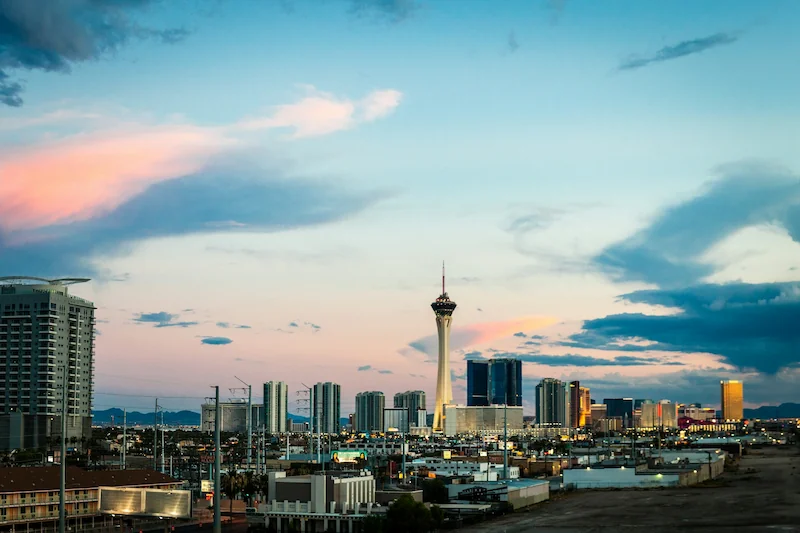
The STRAT Hotel, Casino & Tower – A value-oriented North Strip option with a clear price advantage over more central addresses. Why we recommend: It only makes sense if you understand that price, not centrality, is the main argument here. Check availability
SAHARA Las Vegas – A cleaner-feeling North Strip option that often bridges the gap between budget and proper resort comfort. Why we recommend: It is one of the more convincing North Strip stays when value and hotel quality both matter. Check availability
Treasure Island - TI Las Vegas Hotel & Casino – A large Strip hotel that can work as a lower-cost alternative to more expensive central luxury neighbors. Why we recommend: Its location can be more useful than its price tier suggests, especially for north-central movement. Check availability
Mid
Treasure Island - TI Las Vegas Hotel & Casino – A pragmatic north-central Strip base with broad on-site infrastructure and more useful walking logic than farther-north options. Why we recommend: It remains one of the more usable mid-range answers on the northern side of the Strip. Check availability
SAHARA Las Vegas – A cleaner-feeling North Strip option that can bridge value and proper resort comfort for travelers comfortable with the location. Why we recommend: It has a clearer value proposition than older North Strip stock when you understand the transport trade-off. Check availability
Las Vegas Hilton at Resorts World – A large modern resort option with stronger hotel infrastructure than many older North Strip choices. Why we recommend: A better fit for travelers who want newer resort stock without paying peak central luxury rates. Check availability
Upscale
Fontainebleau Las Vegas – A major new-generation luxury resort with strong hardware and a polished North Strip presence. Why we recommend: One of the clearest reasons to choose North Strip on hotel quality alone. Check availability
Wynn Las Vegas – A benchmark luxury resort at the north-central edge with stronger service, design, and dining than many Strip competitors. Why we recommend: It justifies the location by making the hotel itself a major part of the stay. Check availability
Encore at Wynn Las Vegas – A refined luxury companion to Wynn with a more polished, adult, and hotel-led feel than many central casino resorts. Why we recommend: Excellent when quiet luxury and property quality matter more than being mid-Strip. Check availability
Arts District
The Arts District is a deliberate alternative for travelers who want Las Vegas to feel more local, lower-rise, and food-and-bar led. It is not a full-service resort base and should not be treated as a hidden first-time bargain. Its value is qualitative: breweries, cocktail bars, restaurants, murals, vintage shops, smaller streets, and quick access to Downtown without sleeping directly inside the Fremont noise. It is strongest for repeat visitors, couples who want a different rhythm, and travelers who are comfortable making the Strip a short ride rather than the whole point.
Why stay here: Stay here only if local texture, bars, restaurants, and a calmer off-Strip rhythm are part of the plan. It is a character choice, not a convenience substitute for Central Strip.
Best for: Repeat visitors, food-led stays, couples who want a different urban rhythm, and travelers who do not need a casino resort base
Pros
More local-feeling than the Strip
Good access to bars, breweries, and independent restaurants
Lower-rise environment that feels easier to read on foot
Useful between Downtown and the Strip by rideshare
Strong fit for repeat visitors who want Las Vegas beyond casinos
Best Las Vegas base for travelers who want murals, breweries, vintage shops, and lower-rise streets
Good compromise between Downtown access and a less chaotic overnight feel
Stronger for food-and-bar evenings than for pool or resort days
Cons
Weaker hotel inventory than the Strip
Not a resort stay
Less intuitive for first-time visitors who want classic Vegas at the door
Requires clearer transport planning for major Strip evenings
Can feel underpowered if you expected full-service hotel infrastructure
Hotel depth is limited, so fallback hotels nearby may make more sense than forcing the district
Not ideal in extreme heat if you expected long neighborhood wandering
Requires rideshare for most Strip plans
Nearby highlights
Better access to breweries, cocktail bars, and murals than the main resort corridor
Easier connection to Downtown without sleeping inside Fremont noise
A stronger neighborhood feel than most Las Vegas hotel zones
Good base for mixing local evenings with selective Strip nights
Useful for travelers who want their meals and bars to feel less packaged
Easy connection to Fremont East and Downtown museums
Good base for bar, brewery, and restaurant-led evenings
Useful if you want a Las Vegas stay that feels less packaged
Budget
Main Street Station Casino Brewery Hotel – A characterful Downtown-adjacent value stay with more identity than a generic low-cost room. Why we recommend: Works for travelers who want an old-school and less standardized base near the Arts District / Downtown orbit. Check availability
Oasis at Gold Spike – A low-cost Downtown stay with easy access to Fremont and short rides to the Arts District. Why we recommend: Useful when the priority is nightlife and local-bar access rather than resort polish. Check availability
Downtown Grand Hotel & Casino – A cleaner practical fallback just beyond the Arts District orbit, often easier than forcing a weak neighborhood hotel. Why we recommend: Gives better hotel reliability while keeping Downtown and Arts District plans simple. Check availability
Mid
The English Hotel, Las Vegas, a Tribute Portfolio Hotel – A boutique-leaning stay that fits travelers looking for a more design-aware and lower-pressure Vegas base. Why we recommend: The most natural hotel match for an Arts District-focused stay. Check availability
Downtown Grand Hotel & Casino – A practical Downtown option close enough to work for travelers splitting time between Fremont, Arts District bars, and local dinners. Why we recommend: Often works better in practice than weaker options inside the district orbit. Check availability
Circa Resort & Casino - Adults Only – A stronger hotel product Downtown that can support an Arts District / Fremont style trip with more comfort. Why we recommend: Best if you want nightlife energy and hotel quality without choosing the Strip. Check availability
Upscale
The English Hotel, Las Vegas, a Tribute Portfolio Hotel – The clearest upscale-feeling boutique match for travelers choosing the Arts District deliberately. Why we recommend: It feels aligned with the district rather than imported from the resort corridor. Check availability
Vdara Hotel & Spa at ARIA Las Vegas – A calm non-casino upscale fallback that works for travelers mixing off-Strip dinners with central comfort. Why we recommend: A better premium compromise than forcing a weaker Arts District hotel if comfort matters. Check availability
NoMad Las Vegas – A refined, quieter-feeling hotel-within-a-resort option that pairs well with off-Strip dining plans. Why we recommend: Good for travelers who want design and calm while still keeping rides to the Arts District easy. Check availability
Chinatown
Chinatown and the Spring Mountain Road corridor are among Las Vegas’s strongest food assets, but they are specialist hotel bases. This is the right orbit if you are a repeat visitor, food is central to the trip, and you are happy moving by short rides rather than walking to landmarks. It is not scenic in the classic stay-guide sense, and it will not give you the visual theatre of the Strip outside your door. Its advantage is practical depth: more normal dining rhythm, better value, late-night food access, and a city that suddenly feels less like one giant resort ecosystem.
Why stay here: Stay here if restaurants, off-Strip dining, and repeated short rides define the trip. It is a food-first base for confident travelers, not a first-time default.
Best for: Food-driven return trips, longer off-Strip stays, and travelers who want restaurant depth more than classic Vegas spectacle at the hotel door
Pros
Best off-Strip food access in the city
Good value logic for repeat visitors
More local dining rhythm than resort-heavy zones
Useful for longer stays where restaurant variety matters
Can make Las Vegas feel less repetitive on a return trip
Strongest base for Spring Mountain Road dining and off-Strip value meals
Useful for longer stays that would become repetitive inside resort restaurants
Good for travelers who plan to use a car or rideshare frequently anyway
Cons
Not walkable to the city's best-known landmarks
Limited classic neighborhood atmosphere
Requires transport for almost everything outside the corridor
Weaker choice for a first trip
Can feel too functional if you expected a more scenic urban base
Weak for walkability, views, pools, and classic Vegas atmosphere
Not a good single base for most first-time visitors
Hotel recommendations often work as nearby-orbit fallbacks rather than perfect neighborhood stays
Nearby highlights
Immediate access to one of Las Vegas's strongest restaurant ecosystems
Better value and variety for repeat food-focused stays
Short rides to both Strip and Arts District logic
Useful base when the trip is built around dining more than landmark walking
A stronger sense of living city rhythm than many resort zones
Easy repeated access to Chinatown restaurants without crossing the entire city
Good orbit for Palms / Rio / Gold Coast style off-Strip stays
Useful when the trip is built around meals as much as entertainment
Budget
Gold Coast Hotel and Casino – A practical west-of-Strip value option that works better for Chinatown access than classic first-time resort glamour. Why we recommend: One of the clearer budget-friendly bases for travelers prioritizing food corridors and easy rides. Check availability
Rio Hotel & Casino, a Destination by Hyatt Hotel – A larger off-Strip resort-style option with roomier layouts and workable access to both Chinatown and the Strip. Why we recommend: Useful when room size and off-Strip movement matter more than classic boulevard access. Check availability
Club de Soleil All-Suite Resort – A practical suite-style west-side option for travelers who want more space and do not need Strip-front atmosphere. Why we recommend: A functional longer-stay fallback when dining access and room size matter more than sightseeing walkability. Check availability
Mid
Palms Casino Resort – A stronger-finished off-Strip resort with easier access to Chinatown, the Strip, and local dining than many visitors expect. Why we recommend: A good choice when you want a real hotel product without sleeping in the busiest Strip core. Check availability
Palms Place Hotel and Spa – A calmer, roomier off-Strip stay with suite logic and easy rides to both Spring Mountain Road and the Strip. Why we recommend: Smarter than a weaker central option if the trip is food-led and rideshare-based. Check availability
Westgate Las Vegas Resort & Casino – A large off-Strip resort with monorail access and practical pricing for travelers who do not need central Strip frontage. Why we recommend: Useful as a value-and-logistics compromise when Chinatown and wider city movement both matter. Check availability
Upscale
ARIA Resort & Casino – A strong upscale central base for food-driven travelers who want Chinatown access without giving up Strip quality. Why we recommend: Balances hotel quality and off-Strip dining flexibility better than committing fully to a weaker corridor hotel. Check availability
The Cosmopolitan Of Las Vegas – A high-end central alternative if you want excellent hotel positioning while using Chinatown for repeated dinner detours. Why we recommend: For shorter premium stays, centrality plus off-Strip meals is often more coherent than staying fully off-Strip. Check availability
Vdara Hotel & Spa at ARIA Las Vegas – A quieter upscale option with no casino floor, useful for food-focused travelers who still want central access and calmer room recovery. Why we recommend: A strong compromise for travelers balancing Chinatown meals, Strip access, and a less frantic hotel environment. Check availability
Where to stay in Las Vegas for first-time visitors
For a first Las Vegas trip, location should usually beat theoretical value. The city is more tiring, more spread out, and more internally fragmented than it looks, so the best area is the one that protects your evenings, reduces unnecessary rides, and keeps the classic Strip landmarks easy to use.
Choose Central Strip if the trip is short and built around classic Vegas icons, one or two shows, and strong dinner reservations.
Use South Strip if you still want the Strip but would rather trade some centrality for bigger resorts, easier family logic, or better value.
Avoid North Strip for a first trip unless a specific hotel there is the point of the stay.
Downtown is a better alternative-city choice than a first-time default if your image of Vegas is still tied to the main resort boulevard.
Arts District and Chinatown are better for conscious repeat-visit logic than for a first-trip default.
If your stay is only two nights, being too far from the center costs more in lost time than it saves in room rate.
Stay close to the middle if Bellagio fountains, major shows, Sphere, observation decks, and flagship restaurants are all on the plan.
Choose South Strip only if pool time, room size, or family logistics matter more than walking repeatedly through the central icons.
Do not make Downtown the only base on a first trip unless you actively prefer old-Vegas nightlife over the polished resort corridor.
Profile
Best area
Why
First Vegas weekend
Central Strip
Least friction for landmarks, dinners, and shows
First trip with more resort time
South Strip
More space and stronger pool-family logic
First trip but nightlife-first
Central Strip or Downtown
Depends on whether you want polished resort Vegas or looser Fremont energy
First trip with premium budget
Central Strip
High-end centrality usually delivers more value than a slightly better room farther away
Where to stay in Las Vegas with family
Las Vegas is workable with children, but family convenience rarely means the same thing it does in classic urban destinations. Bigger resort infrastructure, better pool setups, easier room logic, and slightly lower night pressure usually matter more than pure centrality.
South Strip is often the easiest family answer because larger resorts can absorb more of the day without constant cross-city movement.
Central Strip only makes sense for families if the trip is short and landmark-led rather than pool-led.
Downtown is generally weaker for families, especially if the trip leans heavily into late-night Fremont energy.
Look for room layout, pool quality, and internal hotel convenience before brand image.
A calmer upscale hotel can outperform a louder 'better' area if children need quieter resets during the day.
North Strip can work for families only if the hotel itself is doing a lot of the practical work.
Prioritize hotels with good pools, food courts or easy casual meals, and rooms that make midday breaks realistic.
Avoid building family stays around late-night Fremont unless the children are older and the evening is carefully timed.
In summer, a better pool and easier internal resort setup can matter more than being exactly central.
Need
Best area
Why
Bigger resort infrastructure
South Strip
More space, better pool logic, easier slower-paced days
Short family first trip
Central Strip
Reduces transport friction to the classic sights
Adult-centered family trip with better rooms
South Strip
More forgiving room-to-value ratio
Quieter upscale family base
South Strip or selected North Strip hotel
Hotel calm and room comfort can matter more than pure centrality
Where to stay in Las Vegas for nightlife
Nightlife in Las Vegas splits into two broad styles: polished Strip nights and looser Downtown nights. The best area depends on whether you want major resort venues and show-led evenings or faster, rougher, bar-hopping energy.
Choose Central Strip for club nights, major dinners, and a more polished late-night circuit.
Choose Downtown for easier bar-hopping and a tighter evening geography.
Do not stay too far south or north if the trip is built around repeated late returns on foot.
If nightlife is the core purpose of the trip, walking back to the room matters more than pool quality.
Downtown is often the better choice for repeat visitors who are less interested in first-time Strip theater.
Arts District can work for a more local evening style, but it is not the main answer for classic Vegas nightlife.
Groups should choose the area where the night will actually end, because late rides and long walks create friction quickly.
For club-led trips, Central Strip usually beats Downtown; for bar-led trips, Downtown can be more efficient and more fun.
Arts District is strongest for lower-pressure bars, breweries, and cocktails, not for the full nightclub version of Las Vegas.
Nightlife style
Best area
Trade Off
Big-resort, show-led, polished
Central Strip
Higher cost, more foot traffic
Bar-hopping, Fremont-led, looser
Downtown
Rougher edges, weaker classic Strip access
Local bars, breweries, lower-pressure evenings
Arts District
Less classic Vegas spectacle
Where to stay in Las Vegas on a budget
Budget stays in Las Vegas need to be judged by total usefulness, not just by room price. A cheaper hotel in the wrong place can become poor value once resort fees, transport, and lost time are added back in.
The best budget answer is often a usable Strip hotel rather than the absolute cheapest room in the city.
Central-value hotels like LINQ, Flamingo, or Harrah's can outperform lower headline prices elsewhere because the location saves time.
South Strip budget choices work well when room size and resort access matter more than perfect centrality.
Downtown can be a smart value play if you genuinely want Fremont nightlife rather than the classic Strip core.
North Strip only works for budget travelers who are comfortable with transport and not expecting central Strip walkability.
Off-Strip budget logic only works when the hotel still fits the real shape of the trip.
Check resort fees before comparing hotels; the cheapest visible rate can be misleading.
Midweek Central Strip can sometimes be better value than weekend off-Strip compromises.
If you will need rides every night, include that cost before deciding a far hotel is cheaper.
Budget goal
Best area
Why
Cheapest usable Strip stay
Central Strip or South Strip
Better balance between cost and real trip convenience
Lower total nightlife cost
Downtown
Walkable evening density reduces late transport dependence
Lowest room rate
North Strip
Only smart if you accept weaker location logic
Best off-Strip food-value stay
Chinatown orbit
Useful only if food and rideshare-based planning are already the core logic
Where to stay in Las Vegas for luxury
Luxury in Las Vegas is not only about room quality. The best premium stay is usually the one that combines strong hotel hardware with the right location for how the trip actually works.
Choose Central Strip if premium location, dinner access, and evening flexibility matter most.
Choose North Strip if a specific high-end property is the reason you want to stay there.
Choose South Strip for a calmer upscale resort rhythm with stronger pool and room logic.
Do not overvalue hardware at the expense of trip shape on a short stay.
For many first or second premium trips, Bellagio, Cosmopolitan, or a strong central base remain more coherent than a slightly better room farther away.
For short luxury stays, centrality often beats marginally better hardware farther north or south.
For longer luxury stays, quieter towers, spa/pool quality, and room recovery can become more important than being in the busiest core.
If the hotel is the destination, North Strip or South Strip can be justified; if the city is the destination, Central Strip often remains stronger.
Luxury goal
Best area
Why
Classic premium first trip
Central Strip
Best combination of prestige and real usability
Hotel-led stay with new-generation hardware
North Strip
Specific properties can justify the location trade-off
Quieter upscale comfort
South Strip
Better room and resort calm without giving up Strip access entirely
Where to stay in Las Vegas on a repeat visit
Once the first-time Strip checklist is no longer the main goal, Las Vegas opens up. Repeat visitors can choose areas that emphasize nightlife style, food access, better-value comfort, or a more local mood rather than pure landmark convenience.
Downtown becomes much stronger once the classic Strip is no longer the only priority.
Arts District is a real option for travelers who want a more local-feeling urban rhythm.
Chinatown works when dining depth matters more than proximity to major landmarks.
South Strip can be smarter than Central Strip for longer repeat stays where room comfort matters more.
North Strip only works well when the property itself is part of why you are returning.
Repeat visitors should consider splitting the stay if they want both classic resort time and off-Strip food or Downtown nights.
If every previous trip has been Central Strip, Downtown or Arts District can materially change the feel of the city.
Chinatown is most persuasive when you already have a restaurant list and do not care about hotel-door scenery.
Repeat Visit style
Best area
Why
Nightlife and old-Vegas energy
Downtown
More personality and tighter evening movement
Food and local texture
Arts District or Chinatown
Less resort-managed and more contrast-driven
Longer stay with better comfort
South Strip
Room and resort quality start to matter more than centrality
Where to stay in Las Vegas for couples
Couples can use Las Vegas in very different ways: classic romantic spectacle, polished dining, pool recovery, design-led luxury, or a more local cocktail-and-restaurant rhythm. The best base depends on whether the trip is about one big central weekend or a slower stay with better meals and recovery time.
Central Strip is best for first-time couples who want fountains, shows, views, dinners, and late-night walking close together.
South Strip works better for couples who want a calmer suite-style stay, spa time, pools, and less constant crowd pressure.
Arts District is a good repeat-visit choice for couples who prefer bars, restaurants, murals, and lower-rise evening texture.
Downtown is stronger for playful, nightlife-led couples than for refined romantic luxury.
Chinatown is best used as repeated dinner access rather than as the main romantic hotel setting.
For special occasions, choose the hotel and dinner geography together; a beautiful room in the wrong area can still weaken the night.
Couple style
Best area
Why
First romantic Vegas trip
Central Strip
Best combination of spectacle, views, dinners, and late-night ease
Quieter luxury weekend
South Strip or selected North Strip
Better room, spa, and recovery logic
Food and cocktails repeat trip
Arts District or Central Strip
Depends whether local bars or polished resort dining matter more
Where to stay in Las Vegas without a car
Las Vegas is possible without a car, but the hotel base matters more because walking and rideshare replace ordinary city transit for most visitor plans. The best car-free stays reduce repeated cross-town transfers and keep the main evening geography close.
Central Strip is the best answer for most car-free first-timers because the core experiences are closest together.
Downtown works well without a car only if your evenings are Downtown-led and you are not repeatedly heading back to the central Strip.
South Strip can work without a car if you accept more rides to central dinners and shows.
North Strip is less forgiving without a car unless the hotel itself carries much of the stay.
Arts District and Chinatown require rideshare discipline and are not ideal for car-free first trips.
Choose hotels with easy pick-up/drop-off logic; some large resorts make short rides feel slower than expected.
No Car scenario
Best area
Why
First trip
Central Strip
Maximum walkability by Vegas standards
Nightlife trip
Downtown or Central Strip
Pick the area where most nights will end
Food-led repeat stay
Central Strip with Chinatown rides, or Arts District
Works only if ride-hailing is part of the plan
Where to stay in Las Vegas for food
Food-focused travelers should not assume the Strip is the only answer. Las Vegas dining splits between premium resort restaurants, Downtown and Arts District bars, and the deep off-Strip restaurant corridors around Chinatown and Spring Mountain Road.
Central Strip is best if your food plan is built around destination restaurants, pre-show dinners, and polished dining rooms.
Chinatown is best if the trip is about repeated off-Strip meals, value, Asian restaurants, and a more normal city rhythm.
Arts District is strongest for bars, breweries, cocktails, and restaurant-led evenings with less resort polish.
Downtown works well for casual late-night food and bar-hopping rather than luxury dining.
South Strip can be useful for resort dining and pool days, but it is not the best pure food base.
The strongest food trip often stays central and uses Chinatown or Arts District as planned dinner detours.
Food style
Best area
Why
Luxury resort dining
Central Strip
Best access to destination restaurants and show-night timing
Off-Strip value and variety
Chinatown orbit
Best restaurant depth beyond resort pricing
Bars and casual dinners
Arts District or Downtown
More local, social, and less packaged
Where to stay in Las Vegas for pools and resort time
A pool-focused Las Vegas stay follows different rules from a sightseeing stay. The best hotel is the one where you actually want to spend the hottest part of the day, even if that means slightly weaker walkability.
South Strip is often the strongest pool-and-resort answer because larger properties can carry more of the day.
Central Strip works if you want pool time but still plan to use the city intensively at night.
North Strip can work when a specific resort pool or luxury property is the reason for the stay.
Downtown, Arts District, and Chinatown are weaker for pool-led trips because the hotel product is not the main point.
In summer, pool quality, shade, cabana pricing, and room recovery become central planning factors.
For families, a better pool can be more useful than being five minutes closer to the fountains.
Pool style
Best area
Why
Family resort pool
South Strip
Larger properties and more forgiving day structure
Short first trip plus pool
Central Strip
Keeps nighttime plans easy
Luxury hotel-led pool stay
North Strip or South Strip
Specific properties can justify weaker centrality
Where to stay in Las Vegas for conventions, sports, and events
Events can completely change Las Vegas hotel logic. A convention, Raiders game, Golden Knights game, UFC event, major concert, or Formula 1 weekend can make the usual best area less relevant than your venue geography and transport plan.
For Las Vegas Convention Center events, North Strip and selected monorail-connected hotels can make sense.
For T-Mobile Arena, Central Strip and south-central hotels are often easiest.
For Allegiant Stadium, South Strip and nearby resort bases can reduce event-day friction.
For Sphere, Central Strip, Venetian / Palazzo orbit, Wynn / Encore, and selected North Strip hotels all become stronger.
For major event weekends, book much earlier than normal and check the full stay total carefully.
If the event ends late, prioritize the return route over morning sightseeing convenience.
Event type
Best area
Why
Convention center
North Strip or monorail-connected Strip
Reduces work-trip transport friction
Arena shows / Golden Knights
Central Strip
Best late-night return logic
Raiders / stadium events
South Strip
Better event-side geography and airport-side access
Where to stay in Las Vegas for longer stays
Longer Las Vegas stays reward comfort and variety more than pure centrality. Once you move beyond a weekend, the hotel room, food access, pool strategy, and ability to escape the Strip become much more important.
South Strip often improves on longer stays because room size, pools, and resort function matter more.
Vdara-style or suite-style stays can work better than casino-heavy hotels when recovery time matters.
Chinatown becomes more persuasive if repeated off-Strip meals are part of the stay.
Arts District can make a longer repeat trip feel less resort-managed, but only if you are comfortable using rideshare.
Central Strip can become exhausting over a week unless you deliberately build in quieter blocks.
Consider splitting the stay if you want both classic Strip nights and a calmer or food-led second layer.
Longer Stay goal
Best area
Why
Comfort and pools
South Strip
Better room and resort rhythm over several days
Food depth
Chinatown orbit or Central Strip with planned rides
Prevents resort dining fatigue
Classic plus local contrast
Split Central Strip / Arts District or Downtown
Changes the emotional rhythm of the trip
Where to stay based on trip length and trip shape
Trip length and trip purpose change the answer quickly in Las Vegas. The shorter the stay, the more centrality matters; the longer or more specialized the stay, the more room quality, pools, food corridors, event geography, and off-Strip rhythm can become valid trade-offs.
Label
Stay
Avoid
Why
1 night
Central Strip or the exact event-area hotel
off-Strip experiments and far-end bargains
With one night, every transfer hurts; sleep where the evening actually happens.
2 nights
Central Strip
North Strip, Arts District, or Chinatown unless a specific reason overrides convenience
Short stays cannot absorb unnecessary transport, long casino interiors, and repeated corridor walking.
3 days
Central Strip or South Strip
weak-value far-end Strip stays
This is the classic first-trip length, so the base should simplify evenings and keep one or two flexible blocks easy.
4 to 5 days
South Strip, Central Strip, or a stronger Downtown choice depending on trip style
choosing solely by room rate
With more time, resort comfort, pools, or a more distinctive nightlife base can become worth the trade-off.
1 week
South Strip, Arts District, Chinatown orbit, or a premium hotel you genuinely want to spend time in
overpaying for pure centrality if the trip is not constantly Strip-core
Longer stays can justify room comfort, calmer pacing, food variety, and hotel quality as part of the trip.
First trip
Central Strip
Downtown, Arts District, or Chinatown as the only base unless you clearly prefer that style
The city is easier to understand when the main landmarks and best-known resorts are close.
Family trip
South Strip or selected Central Strip resort
Downtown as a default family base
Pools, room layout, easy meals, and shorter activity blocks matter more than old-Vegas nightlife.
Couples trip
Central Strip for spectacle, South Strip for calmer luxury, Arts District for repeat-visit bars and food
choosing a famous hotel disconnected from the nights you actually want
Couples trips succeed when hotel, dinner, show, and recovery logic align.
Food-focused trip
Central Strip with planned Chinatown/Arts District rides, or Chinatown orbit for repeat visitors
eating every meal inside the hotel out of convenience
Vegas food is stronger when the base supports both premium dining and off-Strip depth.
Return trip
Downtown, South Strip, Arts District, Chinatown, or a chosen North Strip luxury property
automatically rebooking centrality out of habit
Once the classic Strip core is no longer the whole point, more interesting trade-offs open up.
How to choose the right Las Vegas hotel once the area is clear
In Las Vegas, the district name only gets you part of the way. The hotel itself still matters because resort fees, internal resort friction, room quality, elevator lines, ride-hailing pickup points, pools, parking, noise, and how easily you can enter and leave the property all shape the stay.
Topic
WhatToDo
WhatToAvoid
WhyItMatters
Street-level usefulness
Check how directly the hotel connects to the part of the Strip or Downtown you actually plan to use.
Assuming any hotel in the right district is equally convenient.
A poorly placed hotel inside the right area can still waste time every day.
Quiet versus branding
Prioritize calmer towers or quieter-feeling properties if sleep quality matters to the trip.
Choosing a louder brand name just because it feels more iconic.
Las Vegas drains energy quickly, and a slightly calmer hotel can improve the whole stay.
Room value
Look for better room quality, suite logic, or calmer layouts when the trip is longer than a weekend.
Paying solely for fame if you will spend meaningful time in the room.
On longer stays, room comfort becomes part of the value equation, not an afterthought.
Resort scale
Choose large integrated resorts only if you actually want pools, dining, and on-site infrastructure.
Booking a giant resort when you really want a simple sleep-and-go base.
Big resorts are useful when they carry the day, but inefficient when you just need a room.
Hotel fees and hidden friction
Budget for resort fees, parking, and likely ride-hailing before comparing options.
Comparing headline room rates in isolation.
The cheapest room is often not the cheapest stay.
Central premium
Pay the central premium on short trips when evenings and first-time efficiency are the main goal.
Downgrading location too aggressively on a 2- or 3-night trip.
A better location often delivers more value than a nicer room on short stays.
Boutique versus chain-style reliability
Choose stronger design or character only if it does not weaken your area logic.
Letting hotel style pull you into a poor base.
In Las Vegas, where you sleep matters more than chasing a concept.
Off-Strip discipline
Only choose Arts District or Chinatown as a base when that rhythm is part of the trip rather than a price compromise.
Treating off-Strip hotel logic as automatically smarter or more authentic.
The right off-Strip stay can add depth, but the wrong one just adds friction.
Event calendar
Check conventions, sports, concerts, F1-related dates, fight weekends, and holiday periods before booking.
Assuming a normal-looking rate means a normal weekend.
Events can distort prices, traffic, restaurant availability, and the feel of entire areas.
Pool and heat logic
In summer, treat pool quality, shade, room recovery, and short transfers as core hotel criteria.
Choosing purely by walking geography when daytime movement will be limited by heat.
Summer Vegas is an indoor-and-pool city for much of the day.
Show-night geography
Map the hotel to your main show, dinner, or arena night before booking.
Assuming rides across the Strip are quick at peak evening times.
The end of the night is when weak hotel geography feels most costly.
Family room function
Prioritize room layout, pools, casual food, and mid-day breaks over image.
Booking the most famous central hotel if it makes the family routine harder.
With children, friction compounds faster than in adult-only trips.
Rideshare and parking
Check hotel pickup/drop-off and parking conditions if you expect to move often.
Ignoring the last 10 minutes inside a resort complex.
In Las Vegas, the practical entry and exit experience can change how usable a hotel feels.
Split-stay logic
Consider a split stay only on longer trips where you want both Strip spectacle and off-Strip or Downtown rhythm.
Splitting a short stay and losing time to luggage logistics.
A split stay can add variety, but only when the trip is long enough to justify it.
FAQ: where to stay in Las Vegas
These are the hotel-location questions that usually decide whether a Las Vegas trip feels smooth, expensive, or badly shaped.
What is the best area to stay in Las Vegas for first-time visitors?
For most first-time visitors, Central Strip is the best area to stay in Las Vegas. It keeps the city’s most recognizable resorts, major restaurants, shows, fountains, and evening options within the easiest reach, which matters much more than many travelers expect on a short trip.
Is it better to stay on the Strip or Downtown in Las Vegas?
Stay on the Strip if the classic Vegas experience is the point of the trip. Stay Downtown if you prefer denser nightlife, lower-friction bar-hopping, older casino character, and a rougher, more social version of the city rather than polished resort centrality.
Which part of the Strip is best to stay on?
Central Strip is usually best for first-timers because it puts Bellagio, Caesars, Venetian / Palazzo, LINQ, major dining, views, and shows in the most usable radius. South Strip is better for families, pools, value, and airport-side logistics, while North Strip works mainly for selected hotel-led stays.
Where should families stay in Las Vegas?
Families usually do best on the South Strip or in larger resorts with strong pool, room, and casual dining logic. Central Strip can work for short landmark-led stays, but it is often more tiring over several days because crowds, long internal walks, and late-night energy build quickly.
What is the best area to stay in Las Vegas for nightlife?
For polished Strip nightlife, clubs, shows, and destination restaurants, stay Central Strip. For faster bar-hopping, Fremont Street, and old-Vegas nightlife, Downtown can be the better base, especially for repeat visitors and adults-only trips.
Where should budget travelers stay in Las Vegas?
Budget travelers should focus on usable value, not just the cheapest room. A lower-cost but central Strip hotel can be smarter than a cheaper far-end or off-Strip hotel that forces repeated rides, long walks, or weak late-night logistics.
Is Central Strip worth the premium?
Usually yes for a first trip or any stay of two to three nights. The premium often buys less wasted time, easier evenings, and better flexibility, which can matter more than upgrading the room itself.
Is South Strip a good place to stay in Las Vegas?
Yes, especially for families, pool-focused trips, better-value resorts, larger rooms, airport-side arrivals, and road-trip combinations. It is weaker if you expect to walk repeatedly to the central Strip icons without using taxis or rideshare.
Is North Strip a good place to stay?
North Strip can be good when a specific hotel is the reason for the stay, or when convention or luxury-resort logic points there. It is not the safest default for short first-time trips because casual walking to the central Strip is less convenient than the map suggests.
Is Downtown Las Vegas a good place to stay?
Downtown is a strong choice for nightlife, old-Vegas character, the Mob Museum, Neon Museum access, and better-value adult stays. It is less compelling for travelers who want polished luxury resorts, pool-heavy days, or classic Strip landmarks outside the door.
Is the Arts District a good area to stay in Las Vegas?
The Arts District can be a good base for repeat visitors who want bars, breweries, restaurants, murals, and a more local rhythm. It is not a classic resort base and should not be chosen as a first-time substitute for the Strip unless that off-Strip style is the point.
Is Chinatown a good place to stay in Las Vegas?
Chinatown works mainly for food-driven repeat visitors who are comfortable using rideshare. It is excellent for restaurant access and off-Strip dining depth, but weak for walkability, resort atmosphere, and first-time sightseeing.
Where should couples stay in Las Vegas?
First-time couples usually do best on the Central Strip for fountains, views, shows, and dinners. Couples wanting quieter luxury may prefer selected South Strip or North Strip properties, while repeat couples who care about bars and restaurants can consider Arts District.
Where should luxury travelers stay in Las Vegas?
Luxury travelers should choose based on both hotel quality and trip geography. Central Strip works best for short premium stays, dining, and classic spectacle; North Strip can work when a specific property is the draw; South Strip can be better for calmer resort time.
Where should I stay in Las Vegas without a car?
Central Strip is the best no-car base for most first-time visitors because more of the classic trip can be done on foot or with short rides. Downtown can work without a car if the trip is nightlife-led, while Arts District and Chinatown require more deliberate rideshare use.
Where should I stay in Las Vegas with a car?
With a car, South Strip, selected off-Strip hotels, and Chinatown-orbit stays become more practical, especially if you plan Red Rock, Hoover Dam, Lake Mead, or food-focused outings. Still check parking costs and hotel exit logistics before booking.
What is the best area to stay for Sphere in Las Vegas?
For Sphere, the Venetian / Palazzo orbit, Wynn / Encore, selected North Strip hotels, and Central Strip hotels with short rides all work well. Choose based on whether Sphere is the main event or one part of a broader central-Strip stay.
What is the best area to stay for Allegiant Stadium?
South Strip and south-central Strip hotels are usually the most convenient for Allegiant Stadium events, especially if you want easier event-day movement and airport-side logic. Central Strip can still work if the rest of the trip is show and dining-led.
What is the best area to stay for T-Mobile Arena?
Central Strip and south-central Strip hotels are strongest for T-Mobile Arena because the arena is integrated into the main resort-and-event geography. Staying too far north or Downtown can add unnecessary late-night friction after games or concerts.
What is the best area to stay for conventions in Las Vegas?
For convention center trips, North Strip, selected monorail-connected hotels, and properties near your specific event venue can make more sense than the classic Central Strip answer. For mixed work-leisure trips, balance venue access with evening plans.
Where should I stay in Las Vegas for food?
Central Strip is best for destination resort dining and pre-show meals. Chinatown is best for off-Strip restaurant depth, while Arts District and Downtown are better for bars, breweries, cocktails, and casual social evenings.
Where should I stay in Las Vegas for pools?
South Strip and selected large resorts are often best for pool-focused stays because the hotel itself can carry more of the day. Central Strip is better if pool time is secondary to shows, views, restaurants, and first-time sightseeing.
Where should I stay in Las Vegas in summer?
In summer, prioritize pool quality, room comfort, easy internal dining, and short transfers. South Strip and calmer resort-led properties often improve because long daytime walks become much less appealing, while Central Strip remains strong if evenings drive the trip.
Where should I stay in Las Vegas in winter?
Winter makes walking more manageable and pool culture less central, so Central Strip and Downtown become stronger for sightseeing, shows, dinners, and nightlife. South Strip still works if room value and resort comfort matter more.
Where should I stay for a 2-night Las Vegas trip?
For two nights, stay Central Strip unless a specific event or hotel changes the logic. Short trips cannot absorb weak geography, and the right central base usually gives more value than a nicer room far from the main plans.
Where should I stay for a one-week Las Vegas trip?
For a week, you can prioritize comfort and variety more than pure centrality. South Strip, suite-style hotels, selected off-Strip stays, Arts District, or Chinatown-orbit choices can work if you want pools, food depth, and a less repetitive rhythm.
Should repeat visitors stay off the Strip?
Often, yes, if they already know the classic Strip and want a different version of the city. Downtown, Arts District, Chinatown, or selected hotel-led North/South Strip choices can make Las Vegas feel broader and less repetitive.
What area should I avoid if I do not want to waste time?
Avoid far-end Strip or weakly connected hotels when your stay is short and packed with central plans. Las Vegas is more spread out than it first appears, so a hotel that looks only slightly off on the map can still become a daily time drain.
How far in advance should I book a Las Vegas hotel?
Book early if location matters, especially for conventions, major sports weekends, concerts, F1-related periods, holidays, and peak spring or autumn dates. Waiting can produce deals, but it often narrows the best locations first.
Are resort fees a big deal in Las Vegas?
Yes. Resort fees can materially change the real cost of a Las Vegas hotel, especially when comparing budget or mid-range options. Always compare the final price after fees, parking, and expected transport, not only the nightly rate shown first.
In Las Vegas, the best hotel is usually the one that protects your time, not the one that only looks good in search results.
Continue planning your Las Vegas trip
Once your hotel base is clear, the rest of the trip gets easier to structure. Use the full Las Vegas city guide to understand the city’s zones and energy bands, then use the things-to-do guide to decide which shows, museums, off-Strip experiences, and desert excursions actually fit your base.
Turn the right neighborhood into the right itinerary
Once you know where to stay in Las Vegas, the next step is structuring the rest of your trip around that base. Use the planner to build a route that fits your pace, priorities, and how you actually want your days to unfold.