Find the best areas to stay in Munich with a clear understanding of how each base changes the trip. Munich is easy to navigate, but the right hotel location still matters: Altstadt-Lehel makes a short first visit seamless, Maxvorstadt turns museums into the natural rhythm of the stay, Glockenbachviertel improves evenings, Schwabing and Haidhausen make the city calmer, Ludwigsvorstadt-Isarvorstadt solves rail and Oktoberfest logistics, and Olympiapark only makes sense when the northern cluster is truly central to your plans.
Best areas
Altstadt-Lehel is best for first-timers and short stays, Maxvorstadt for museums and culture, Glockenbachviertel for restaurants and bars, Schwabing for green space and longer stays, Haidhausen for families and calmer local evenings, Ludwigsvorstadt-Isarvorstadt for Hauptbahnhof, budget and Oktoberfest logistics, and Olympiapark for BMW, events and the northern modern cluster.
Booking timing
Book early for Altstadt-Lehel, Oktoberfest, Christmas markets, major trade fairs, FC Bayern match weekends, concerts, and any stay where walkability or a specific district matters. For Oktoberfest, hotel choice becomes a citywide problem, not just a Theresienwiese problem.
Best areas to stay in Munich at a glance
Altstadt-Lehel – Best for: first-time visitors and short stays · Vibe: Historic, central, polished, and highly walkable. · Stay here if: You want Marienplatz, the Residenz, Viktualienmarkt, churches, and classic beer halls close enough to reach on foot. · Avoid if: You want lower hotel prices, quieter evenings, or a more residential Munich base.
Maxvorstadt – Best for: museums, culture, and elegant central access · Vibe: Cultured, ordered, intellectual, and well connected. · Stay here if: You want the Pinakotheken, Königsplatz, Lenbachhaus, Museum Brandhorst, and the old town within a practical radius. · Avoid if: You want the densest nightlife or old-town landmark views from the hotel doorstep.
Glockenbachviertel – Best for: restaurants, bars, couples, and local evenings · Vibe: Social, independent, contemporary, and lived-in. · Stay here if: You want a central-adjacent base with better evening texture than the old town. · Avoid if: You need very quiet nights, grand hotel settings, or immediate access to major museums.
Schwabing – Best for: green space, longer stays, and calmer city breaks · Vibe: Leafy, established, relaxed, and residential. · Stay here if: You want easy access to the English Garden and a quieter base with cafés and good transport. · Avoid if: You want to walk to every first-time landmark in minutes.
Haidhausen – Best for: families, relaxed stays, and local restaurants · Vibe: Village-like, calm, well connected, and quietly elegant. · Stay here if: You want a softer residential base near the Isar, Deutsches Museum, and strong transit links. · Avoid if: You want old-town energy immediately outside the hotel.
Ludwigsvorstadt-Isarvorstadt – Best for: rail arrivals, budget logic, and Oktoberfest access · Vibe: Practical, mixed, central-adjacent, and highly connected. · Stay here if: You want station access, Theresienwiese proximity, and more hotel choice than the old town. · Avoid if: You want Munich’s most polished or atmospheric base.
Olympiapark – Best for: BMW, events, concerts, and modern Munich · Vibe: Open, modern, architectural, and purpose-led. · Stay here if: Your trip is built around BMW Welt, BMW Museum, Olympiapark events, Olympic Hall, family attractions, or northern Munich logistics. · Avoid if: You are planning a classic first-time sightseeing trip focused on Marienplatz, the Residenz, museums, and old-town evenings.
How to choose where to stay in Munich
Choosing where to stay in Munich is less about finding one universal best neighborhood and more about deciding what should be effortless every day. The city is orderly and well connected, but its best experiences sit in separate clusters: the old town, the museum district, the Isar, the English Garden, Nymphenburg, Olympiapark, BMW Welt, Allianz Arena and Theresienwiese all pull the itinerary in different directions. A strong base protects the trip’s main logic — walkability, culture, evening atmosphere, family calm, budget control, Oktoberfest access or event logistics — instead of forcing repeated cross-city transfers.
Choose Altstadt-Lehel if every wasted minute matters more than hotel value, especially on a first visit or 2–3 night stay.
Choose Maxvorstadt if museums, galleries, university-side cafés and a calmer central rhythm are central to the trip.
Choose Glockenbachviertel when restaurants, bars, couples’ stays and a less formal evening scene matter more than postcard views.
Choose Schwabing or Haidhausen if quieter streets, families, longer stays, local restaurants and outdoor breaks outweigh instant landmark access.
Choose Ludwigsvorstadt-Isarvorstadt for Hauptbahnhof, Theresienwiese, budget flexibility and Oktoberfest logistics, but inspect the exact street carefully.
Choose Olympiapark only when your trip is genuinely built around BMW, Olympic Park events, concerts, family attractions or the northern modern cluster.
Treat Westend, Sendling, Au, Lehel, Nymphenburg and the Hauptbahnhof micro-area as useful secondary areas to compare rather than automatic main bases for most visitors.
Munich stay geography: how the map affects your hotel choice
Munich looks compact at first because the old town is walkable, but the best hotel choice depends on which parts of the city you want to make effortless. The Altstadt, museum quarter, Isar-side neighborhoods, northern modern cluster, palace zone, Allianz Arena, Theresienwiese, Hauptbahnhof and airport links all pull in different directions. A good base reduces repeated crossings rather than placing you in the mathematical center of the map.
The Altstadt is the walkable sightseeing core, but it is not where every important Munich experience sits.
Maxvorstadt connects culture and central access better than most districts.
Glockenbachviertel and Haidhausen improve evening quality without fully disconnecting you from sightseeing.
Schwabing works best when the English Garden and calmer streets matter more than old-town immediacy.
Olympiapark, BMW Welt, Allianz Arena and Nymphenburg are outer clusters, not casual extensions of Marienplatz.
Ludwigsvorstadt-Isarvorstadt and the Hauptbahnhof area are useful, but exact street choice matters more there than in Munich’s calmer districts.
Westend, Sendling, Au and Nymphenburg can be useful secondary hotel areas to compare, but they are not stronger all-purpose bases than the main areas for most visitors.
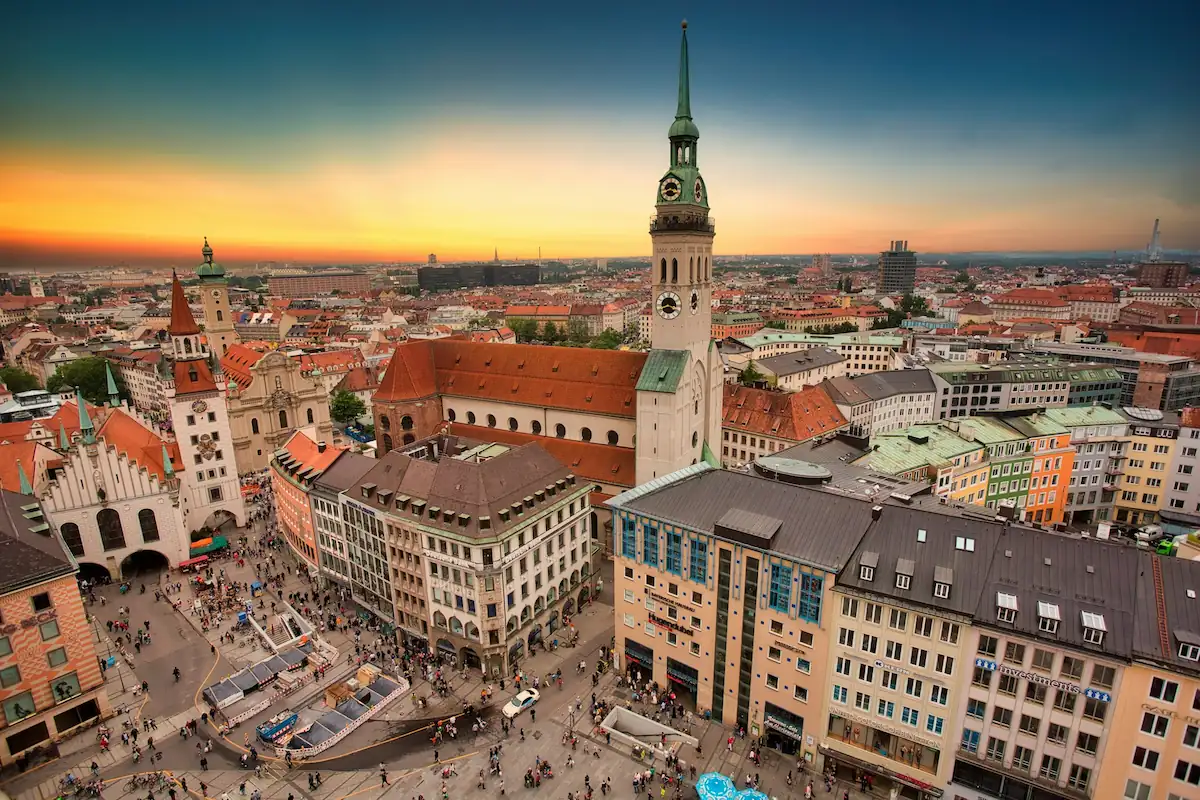
Hyper-central Munich – Altstadt-Lehel gives the shortest walks to Marienplatz, Viktualienmarkt, the Residenz, Hofgarten, Frauenkirche, Alter Peter, Asamkirche and classic beer halls.
Culture-first central north – Maxvorstadt is the best stay geography for the Pinakothek museums, Königsplatz, Lenbachhaus, Museum Brandhorst, Glyptothek, NS-Dokumentationszentrum and university-side cafés.
Local evening south and east – Glockenbachviertel and Haidhausen make dinners, bars, cafés, Isar walks and quieter returns easier than staying only in the old town.
Green residential north – Schwabing suits travelers who want the English Garden, calmer streets, cafés and a more residential Munich base.
Station and Oktoberfest logistics – Ludwigsvorstadt-Isarvorstadt is practical for Hauptbahnhof, Theresienwiese, Sendlinger Tor edges and value-oriented stays, but it demands careful hotel selection.
Event and modern Munich cluster – Olympiapark works for BMW Welt, BMW Museum, concerts, family attractions and Olympic Park, but it is not the most efficient base for old-town sightseeing.
Secondary search areas – Westend, Sendling, Au and Nymphenburg can work for specific budgets, local stays or palace access, but they should usually be compared against the core areas before being chosen.
Best areas to stay in Munich
Munich’s best areas to stay are not interchangeable. Some make a first visit seamless, others make the city calmer, more cultural, more social, more affordable or more event-friendly. The smartest hotel choice begins with the trip type, then narrows to the exact street and property: an Altstadt hotel can save hours on a short stay, a Maxvorstadt hotel can turn museums into a natural half-day, and a Haidhausen or Schwabing base can make a longer stay feel more livable.
Altstadt-Lehel
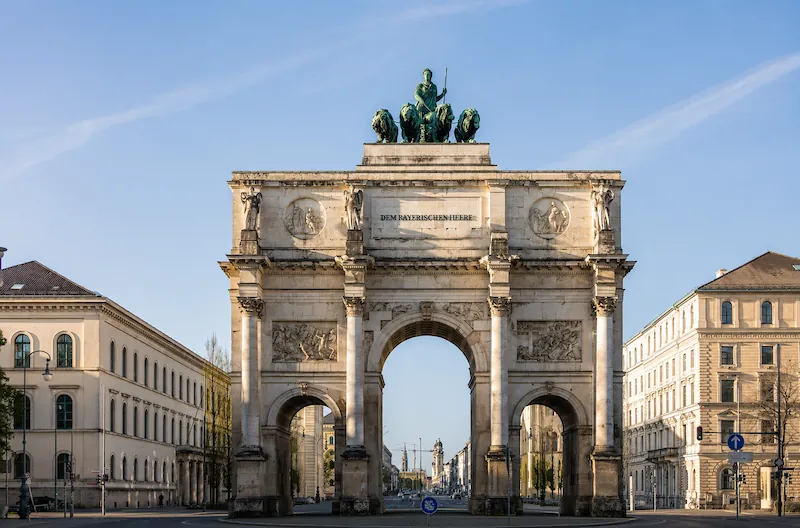
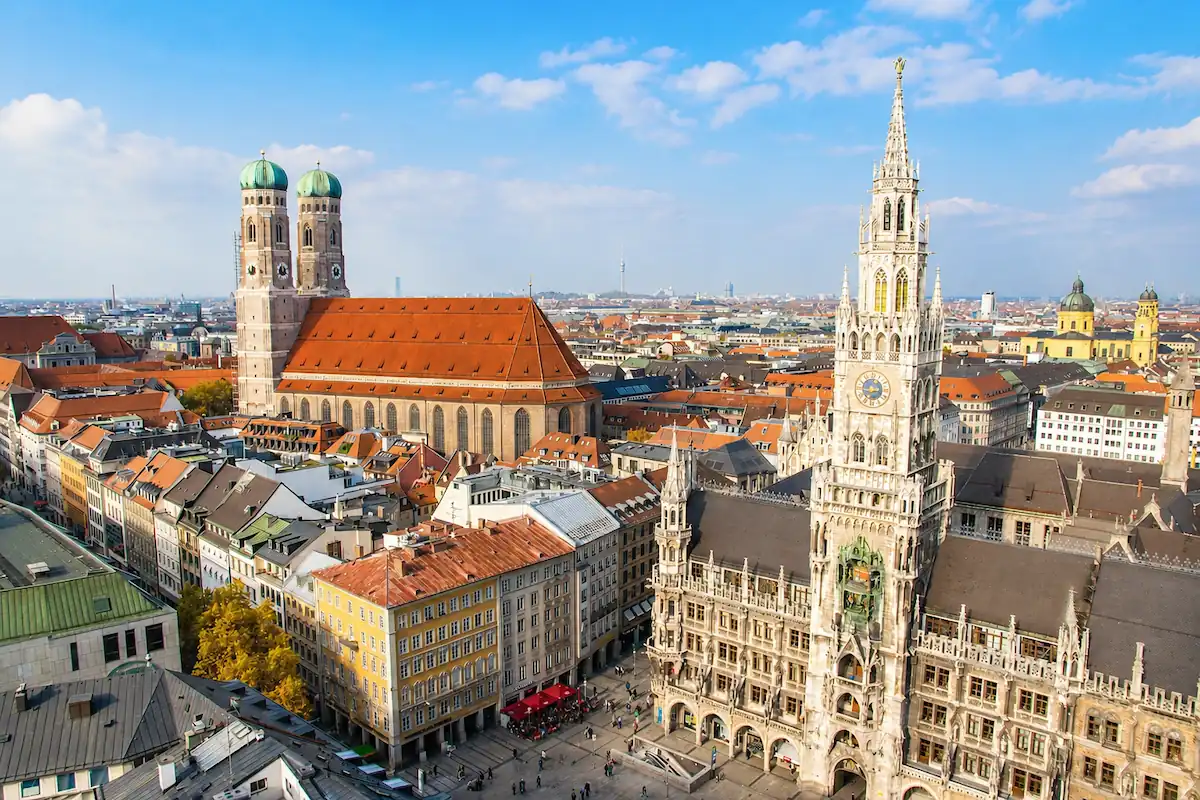
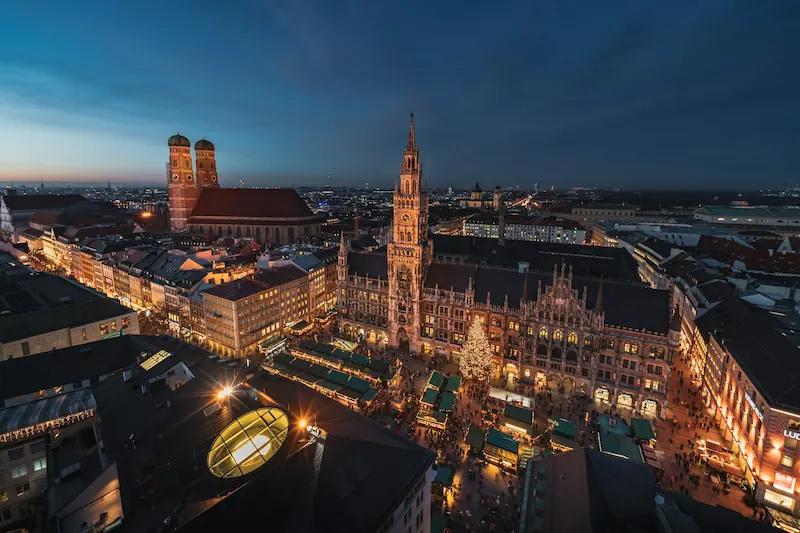
Altstadt-Lehel is the most convenient area to stay in Munich for a first visit, especially if you have two or three days. This is where Marienplatz, the Residenz, Viktualienmarkt, Frauenkirche, Peterskirche, Hofgarten, Odeonsplatz, Asamkirche and classic beer halls sit within a tight walking radius. The district feels formal and polished, with stone streets, historic façades and a steady flow of visitors from morning to evening. Staying here removes almost all sightseeing friction, but it also puts you in Munich’s most expensive and most touristed accommodation zone, especially during Christmas markets, Oktoberfest spillover and peak summer weekends.
Why stay here: Stay here when Munich needs to be easy, central and walkable. It is the strongest base for a short trip, a first-time itinerary, winter sightseeing, luxury hotels, or anyone who wants major sights close without relying on transport.
Best for: First-time visitors, short stays, landmark-focused trips, luxury hotels, Christmas markets, rainy-day convenience and travelers who want the most convenient central base.
Pros
Best area in Munich for first-time visitors who want maximum walkability.
Immediate access to Marienplatz, Viktualienmarkt, the Residenz, Hofgarten, Frauenkirche, Alter Peter and old-town churches.
Strong choice for 1–3 night trips where location saves meaningful time.
Best luxury-hotel concentration and most classic Munich atmosphere.
Evening beer halls, traditional restaurants and Christmas market areas are easy to reach on foot.
Useful in winter or rain because you can return to the hotel between indoor sightseeing blocks.
Cons
Hotel prices are among the highest in Munich, especially during events, Christmas markets and Oktoberfest season.
The area can feel busy, polished and visitor-heavy during the day.
Some rooms in older central buildings may be smaller than expected.
Less local evening texture than Glockenbachviertel, Haidhausen or Schwabing.
Not the best value for longer stays if you are comfortable using public transport.
Nearby highlights
Walk to Marienplatz before the square fills with day visitors.
Reach the Residenz, Hofgarten, Odeonsplatz and Cuvilliés Theatre without building a separate transport plan.
Use Viktualienmarkt for quick lunches, market food and informal daytime breaks.
Pair Frauenkirche, Alter Peter, Asamkirche and central lanes into one compact old-town circuit.
Return easily to the hotel between sightseeing blocks, especially useful in winter, with children or during rain.
Reach classic beer halls, central restaurants, Christmas markets and evening walks without late-night transit.
Budget
Hotel Am Markt – Simple central hotel beside Viktualienmarkt, best for travelers who care more about location than extra facilities. Why we recommend: One of the few lower-priced stays that keeps you genuinely inside the old-town sightseeing core. Check availability
Hotel Blauer Bock – Straightforward old-town hotel close to Viktualienmarkt and Marienplatz, with a practical central address. Why we recommend: Useful for short stays where walkability matters more than boutique character. Check availability
Hotel Lux – Small central hotel near the old town’s core sights, suitable for travelers who want nightlife and landmarks close together. Why we recommend: A compact option in a location where true budget choices are limited. Check availability
Mid
Hotel Torbräu – Classic Munich hotel near Isartor and the old town, with comfortable rooms and strong walking access. Why we recommend: It combines old-town convenience with a slightly calmer edge than Marienplatz itself. Check availability
Platzl Hotel – Traditional central hotel close to Marienplatz, Hofbräuhaus, and the Residenz, suited to a classic Munich stay. Why we recommend: Better for travelers who want Bavarian character without giving up prime location. Check availability
Cortiina Hotel – Design-conscious central hotel with a quieter, more contemporary feel than many old-town properties. Why we recommend: A stronger boutique-leaning choice for travelers who dislike heavy traditional styling. Check availability
Upscale
Louis Hotel – Stylish hotel beside Viktualienmarkt with a refined but understated central Munich feel. Why we recommend: It gives one of the best combinations of old-town location and contemporary restraint. Check availability
Hotel Bayerischer Hof – Grand Munich luxury hotel close to the old town’s major sights, restaurants, and shopping streets. Why we recommend: Best for travelers who want the city’s classic luxury-hotel experience in the central core. Check availability
Mandarin Oriental, Munich – High-end hotel near the old town with polished service, calm interiors, and strong access to central sights. Why we recommend: A premium choice for travelers who want luxury without being directly on the busiest square. Check availability
Maxvorstadt
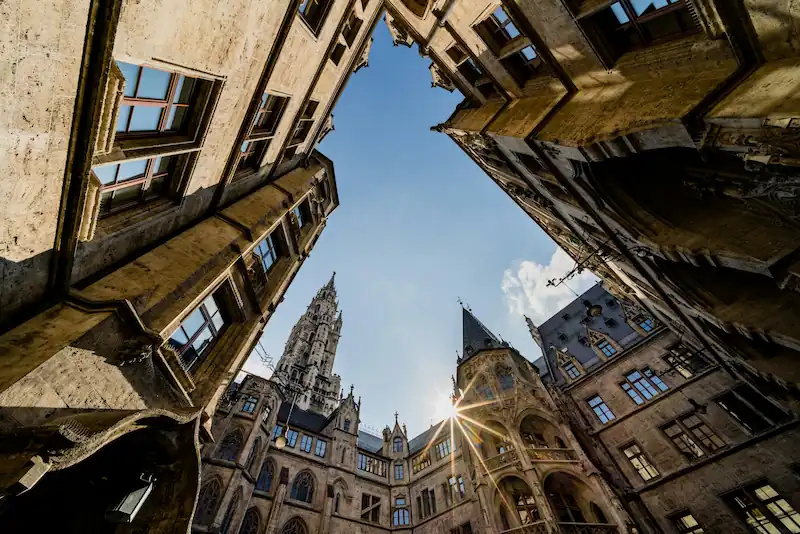
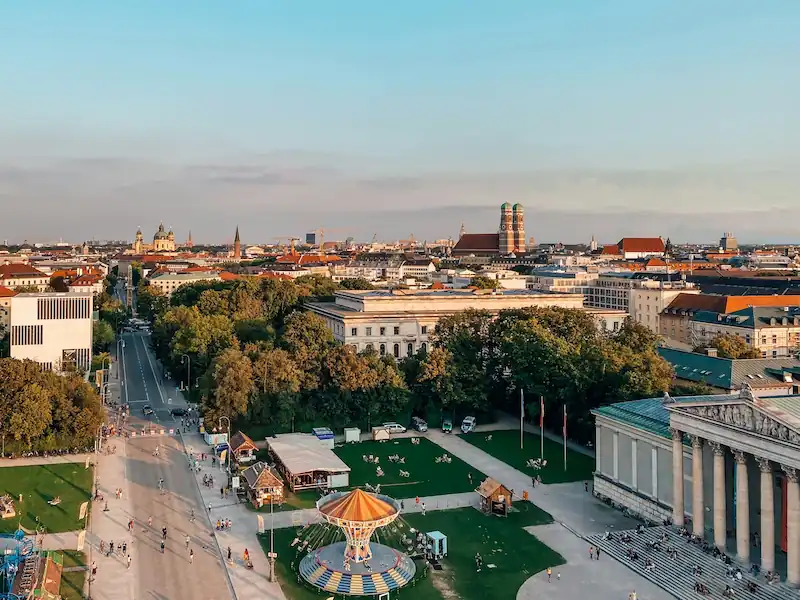
Maxvorstadt is the best area to stay in Munich if museums, galleries and cultural depth shape the trip. It sits just north of the old town, close enough to stay efficient but far enough to feel less touristed. Broad streets, museum façades, university buildings, cafés and bookshops give the district a more composed rhythm. The Alte Pinakothek, Pinakothek der Moderne, Museum Brandhorst, Lenbachhaus, Königsplatz, Glyptothek and NS-Dokumentationszentrum make it the strongest base for travelers who want Munich to feel serious and cultured rather than only traditional.
Why stay here: Stay here when you want Munich to feel cultured rather than only historic. It is especially strong for visitors planning museum time, solo travelers, couples, repeat visitors and anyone who wants central access without sleeping in the busiest old-town streets.
Best for: Museum lovers, culture-first stays, solo travelers, couples, repeat visitors, rainy-day planning and visitors who want central access with more breathing room.
Pros
Excellent base for museums, galleries, architecture and cultural sightseeing.
Practical walking or short-transit access to Altstadt-Lehel without staying in the busiest streets.
Good choice for solo travelers, couples, culture-first trips and return visitors.
More spacious and less tourist-saturated than the old town.
Strong cafés, casual restaurants, bookshops and university-area energy nearby.
Better rainy-day logic than most districts because major museums sit close together.
Cons
Less immediate old-town atmosphere than Altstadt-Lehel.
Evenings are calmer than Glockenbachviertel or classic beer-hall zones.
Not every hotel sits equally close to the museum core, so exact location matters.
Some streets feel functional or station-adjacent rather than atmospheric.
Not the most convenient base for Allianz Arena, Nymphenburg or airport transfers.
Nearby highlights
Walk easily to the Alte Pinakothek, Pinakothek der Moderne, Museum Brandhorst, Lenbachhaus and Glyptothek.
Use Königsplatz and the NS-Dokumentationszentrum as a structured history-and-culture block.
Reach Odeonsplatz, the Residenz, Hofgarten and the Altstadt without committing to an old-town hotel.
Stay close to university cafés, bookstores and a more everyday central Munich rhythm.
Move north toward Schwabing and the English Garden without crossing the entire city.
Build rainy-day plans more easily because museums and cafés are concentrated nearby.
Budget
ibis Hotel München City – Functional hotel near the northern side of the main station and within reach of Maxvorstadt’s museum district. Why we recommend: A practical lower-cost option for travelers who want access without old-town pricing. Check availability
KING's Hotel First Class – Traditional hotel near the station edge of Maxvorstadt, useful for rail arrivals and museum access. Why we recommend: It works when transport convenience and a solid room matter more than neighborhood charm. Check availability
Hotel Antares – Modest hotel close to the museum quarter and English Garden side of central Munich. Why we recommend: One of the more useful budget-leaning addresses for staying near the Pinakotheken. Check availability
Mid
Ruby Lilly Hotel Munich – Design-led hotel on the Maxvorstadt side of the city, close to museums and central transport. Why we recommend: It adds more style than many mid-range hotels in this practical central band. Check availability
Hotel Europa – Reliable mid-range hotel north of the old town with good transport and access to Maxvorstadt. Why we recommend: A balanced choice when room comfort and location matter more than boutique personality. Check availability
NH Collection München Bavaria – Modern hotel by the main station with easy access to Maxvorstadt, the old town, and rail connections. Why we recommend: Useful for travelers who want a sharper room product without sacrificing logistics. Check availability
Upscale
Rocco Forte The Charles Hotel – Luxury hotel by the Old Botanical Garden, between the station, Maxvorstadt, and the old town. Why we recommend: One of the strongest upscale choices for combining culture, calm, and central access. Check availability
25hours Hotel The Royal Bavarian – Design-forward hotel near the station with playful interiors and good access to central districts. Why we recommend: Better for travelers who want personality and transport convenience in the same stay. Check availability
Roomers Munich, Autograph Collection – Upscale design hotel west of the station, stronger on atmosphere and room style than classic sightseeing proximity. Why we recommend: A good fit when hotel character matters and you are comfortable using transit or taxis. Check availability
Glockenbachviertel
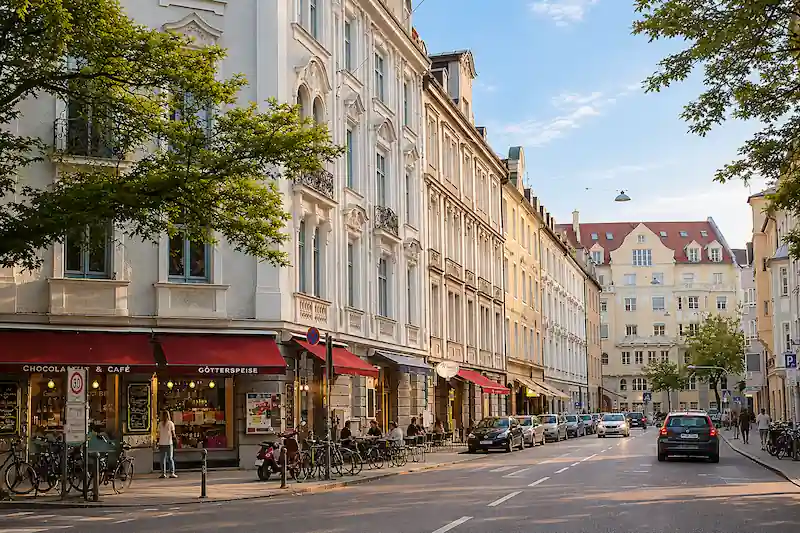
Glockenbachviertel is the best area to stay in Munich for a more social, restaurant-led and contemporary city break. It sits south of the old town, close enough to keep sightseeing practical but with a different evening texture. Streets feel narrower, cafés more local, and dinner choices less dependent on traditional beer halls. As evening arrives, warm light from small bars, wine bars and restaurants gives the district a lived rhythm that the old town often lacks, making it especially useful for couples and return visitors.
Why stay here: Stay here when you want Munich to feel less formal without moving too far from the center. It is especially good for couples, younger travelers, food-focused trips, boutique-hotel stays and visitors who want evenings close to the hotel.
Best for: Couples, restaurants, bars, boutique hotels, LGBTQ-friendly local energy, repeat visitors and travelers who want central access without old-town formality.
Pros
Best Munich base for restaurants, bars and local evening energy.
Close enough to the old town for sightseeing without staying in the most touristed streets.
Good access to the Isar, Gärtnerplatz, Sendlinger Tor and southern central neighborhoods.
Stronger boutique and lifestyle-hotel logic than many central districts.
Works well for couples and return visitors who want more neighborhood character.
More contemporary feel than Altstadt beer-hall corridors.
Cons
Can be noisy on some streets, especially near bars and late-night corners.
Less convenient for museum-heavy plans in Maxvorstadt.
Premium boutique options can price close to old-town hotels.
Not the most obvious choice for families seeking quiet and space.
Less practical for very short first visits if every minute needs to be sightseeing-efficient.
Nearby highlights
Walk into the old town while sleeping in a more local evening district.
Use the Isar riverbanks for late-afternoon resets close to the hotel.
Find better dinner variety than in the most traditional tourist center.
Stay near cafés, bars, small restaurants, wine bars and independent shops.
Reach Sendlinger Tor, Gärtnerplatz and southern old-town sights without long transfers.
Make evenings easy without planning taxis or late transit.
Budget
Motel One München-Sendlinger Tor – Reliable value-oriented hotel near Sendlinger Tor, close to the old town and Glockenbachviertel. Why we recommend: A practical choice when you want central access without paying full old-town prices. Check availability
Cocoon Sendlinger Tor – Casual design hotel near the southern edge of the old town and Glockenbachviertel. Why we recommend: It brings more personality than many budget options in this central-south location. Check availability
Hotel Deutsche Eiche – Longstanding hotel in the southern central area, close to Glockenbachviertel and the old town. Why we recommend: Useful for travelers who want a local, central-south base with character. Check availability
Mid
MOMA1890 Boutique Hotel – Independent boutique hotel with a more intimate feel, well suited to travelers who want character over chain predictability. Why we recommend: A good fit for design-conscious stays that still need strong transport access. Check availability
Living Hotel Prinzessin Elisabeth – Apartment-style hotel near the Isar with a calmer setting south of the old town. Why we recommend: Better than standard rooms for longer stays or travelers who want more space. Check availability
Hotel Olympic – Small hotel in the Glockenbachviertel area, suited to travelers who prefer independent addresses. Why we recommend: A more personal option in one of Munich’s best local evening districts. Check availability
Upscale
The Flushing Meadows Hotel – Design-focused hotel with loft-style rooms near Glockenbachviertel and the Isar. Why we recommend: One of the strongest boutique choices for travelers who want a less traditional Munich stay. Check availability
Hotel München Palace – Elegant upscale hotel east of the center with calm interiors and polished service. Why we recommend: A refined choice when you want quieter luxury away from the busiest old-town streets. Check availability
JAMS Music Hotel Munich – Lifestyle hotel near the eastern central districts with a stronger design and music identity. Why we recommend: Good for travelers who want boutique character and do not need to sleep directly in the old town. Check availability
Schwabing
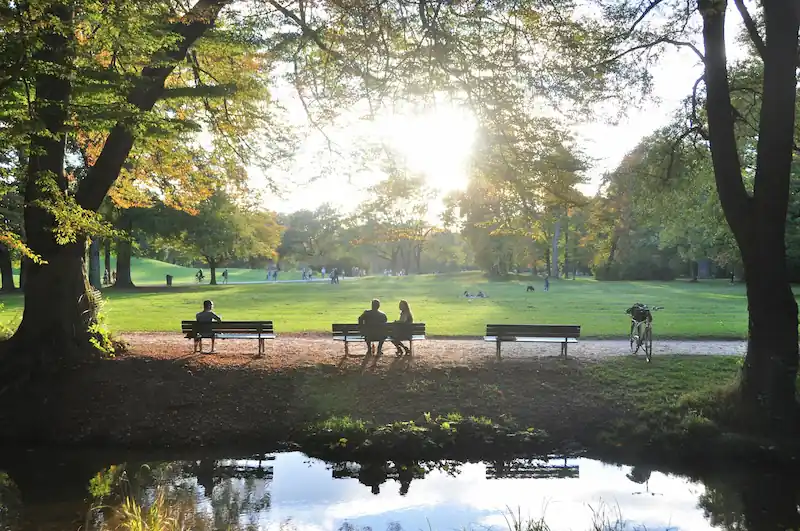
Schwabing is a strong area to stay in Munich when you want greenery, cafés and a calmer residential base without feeling disconnected. It sits north of the center, close to the English Garden and well connected by U-Bahn. The district feels more spacious than the old town, with wider streets, trees, university traces, local restaurants and a slower daily pace. It suits travelers who want Munich to breathe rather than compress every experience into the historic core, especially on longer stays.
Why stay here: Stay here when parks, quiet evenings, room comfort and a more residential rhythm matter more than immediate landmark density. It works especially well for longer stays, families, repeat visitors and travelers who want easy English Garden access.
Best for: Families, longer stays, park access, quieter evenings, repeat visitors and travelers who prefer residential Munich over maximum centrality.
Pros
Excellent access to the English Garden, Schwabing cafés and northern green spaces.
Calmer than the old town while still well connected by public transport.
Good for families, longer stays and travelers who value room comfort.
More residential rhythm with cafés, restaurants and local streets.
Useful base for combining Munich culture with outdoor downtime.
Good alternative when Altstadt-Lehel prices are too high but you still want a desirable neighborhood.
Cons
Less efficient for very short first-time trips focused on the Altstadt.
Hotel location varies significantly between central Schwabing and farther northern addresses.
Evenings are quieter than Glockenbachviertel or the old town.
Some stays require regular U-Bahn use rather than walking.
Can become too far north if the hotel is chosen only by price.
Nearby highlights
Reach the English Garden easily for morning walks, beer gardens, and open-air breaks.
Stay near cafés and restaurants without the intensity of the old town.
Move south toward Maxvorstadt’s museums or north toward quieter residential streets.
Use the U-Bahn to reach Marienplatz efficiently while sleeping in a calmer district.
Make a longer Munich stay feel less compressed and more livable.
Balance cultural days with green space close to the hotel.
Budget
Motel One München-Olympia Gate – Reliable value hotel between Schwabing and the Olympic Park area, with good transport nearby. Why we recommend: A sensible lower-cost choice when northern access matters more than old-town proximity. Check availability
ibis München City Nord – Functional hotel in northern Munich with access toward Schwabing, the English Garden, and transit. Why we recommend: Best for travelers who want predictable basics and are comfortable staying outside the central core. Check availability
Super 8 by Wyndham Munich City North – Budget-friendly chain hotel north of Schwabing, suited to travelers prioritizing price and transit access. Why we recommend: It works when value matters more than neighborhood charm. Check availability
Mid
Pullman Munich – Large modern hotel in northern Schwabing with comfortable rooms and strong U-Bahn access. Why we recommend: A practical choice for travelers who want space, reliability, and quick transport. Check availability
Flemings Hotel München-Schwabing – Contemporary hotel near Leopoldstrasse, useful for Schwabing stays with good city connections. Why we recommend: It gives better neighborhood logic than many generic northern business hotels. Check availability
Mercure Hotel München Schwabing – Compact mid-range hotel in Schwabing, close to local streets and public transport. Why we recommend: A straightforward option for travelers who want Schwabing’s location without boutique pricing. Check availability
Upscale
Andaz Munich Schwabinger Tor – Modern upscale hotel in Schwabinger Tor with spacious rooms, strong design, and polished facilities. Why we recommend: The best premium option for travelers who want contemporary Munich outside the old town. Check availability
INNSiDE by Meliá München Parkstadt Schwabing – Design-led hotel in the northern business side of Schwabing, useful for modern stays and transit access. Why we recommend: A stronger fit for travelers who want clean contemporary rooms rather than historic atmosphere. Check availability
Munich Marriott Hotel – Large upscale hotel in northern Schwabing with reliable facilities and strong transport connections. Why we recommend: Good for families or travelers who value predictable comfort and larger-hotel amenities. Check availability
Haidhausen
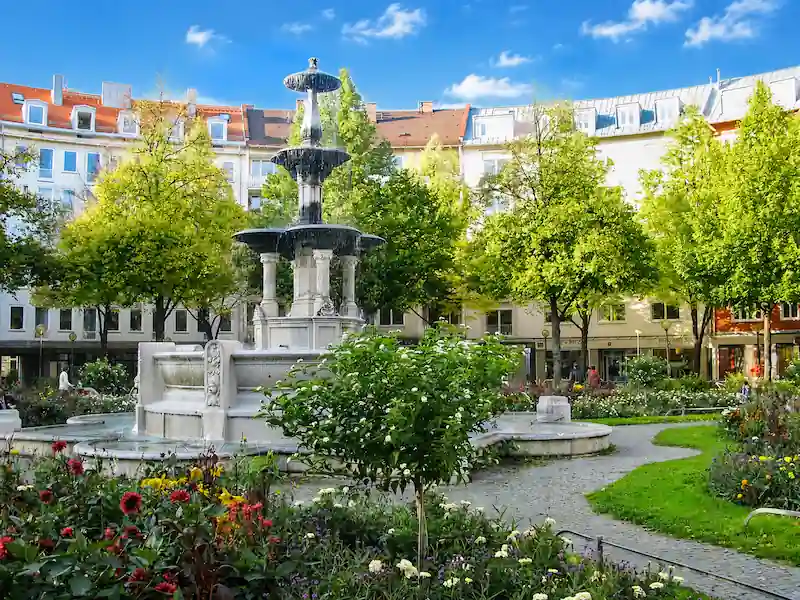
Haidhausen is one of the best Munich neighborhoods for a calmer, more local stay with good transport. East of the Isar, it feels less ceremonial than the old town and more settled, with small squares, cafés, restaurants and residential streets. The district works especially well when you want to return at night to somewhere quieter but not disconnected. It is also practical for the Deutsches Museum, Isar walks, Ostbahnhof connections and families who need a softer base.
Why stay here: Stay here if you want a relaxed base that still keeps the center, the Deutsches Museum, the Isar and Ostbahnhof connections practical. It is one of Munich’s best compromises for families, longer stays and quieter evenings.
Best for: Families, relaxed couples, longer stays, local restaurants, quieter evenings, Isar access and travelers who want a balanced Munich base.
Pros
Calmer and more residential than the old town while remaining well connected.
Strong choice for families and travelers who value quieter evenings.
Good restaurant and café scene without a tourist-heavy feel.
Easy access to the Isar and Deutsches Museum.
Ostbahnhof gives useful transport options for regional and city movement.
Better for longer stays than many tighter old-town addresses.
Cons
Not as immediately convenient for first-time landmark sightseeing as Altstadt-Lehel.
Hotel choice is more limited than in central or station-adjacent districts.
Some addresses feel more residential than atmospheric for a short visitor stay.
Requires transport or longer walks for several major sights.
Less obvious for nightlife-heavy trips.
Nearby highlights
Stay close to the Deutsches Museum without sleeping in the old town.
Use the Isar riverbanks for walks and outdoor pauses.
Return to calmer squares and local restaurants after central sightseeing.
Use Ostbahnhof for transport connections across Munich and beyond.
Reach the old town quickly while avoiding its busiest hotel streets.
Make longer stays feel more residential and less visitor-driven.
Budget
Motel One München-East Side – Reliable value hotel near Munich’s eastern central districts, useful for Haidhausen and Ostbahnhof access. Why we recommend: A practical choice when you want predictability and good transport east of the center. Check availability
Motel One München-Deutsches Museum – Value-oriented hotel near the Isar and Deutsches Museum, within reach of Haidhausen. Why we recommend: Good for travelers who want lower pricing without moving far from central Munich. Check availability
Holiday Inn Munich City Centre – Large practical hotel near Rosenheimer Platz, between Haidhausen and the old town. Why we recommend: Useful for families and transit-focused stays because the location is highly functional. Check availability
Mid
Motel One München-Haidhausen – Modern, efficient hotel in Haidhausen with easy access to eastern central Munich. Why we recommend: One of the most straightforward choices for sleeping in the neighborhood without overpaying. Check availability
Novotel München City – Comfortable hotel near the Isar and Deutsches Museum, suitable for families and practical city stays. Why we recommend: A strong family-friendly option with better room practicality than many boutique properties. Check availability
Residence Inn by Marriott Munich City East – Apartment-style hotel near Munich East, with more space and practical facilities for longer stays. Why we recommend: Better for families or extended visits that benefit from extra room function. Check availability
Upscale
JAMS Music Hotel Munich – Lifestyle hotel with a music-led identity near the eastern central districts and Haidhausen. Why we recommend: A more characterful option than standard business hotels in this part of Munich. Check availability
Hotel München Palace – Elegant upscale hotel near the eastern side of central Munich, with calm rooms and polished service. Why we recommend: Good for travelers who want a refined stay away from the busiest old-town streets. Check availability
Hilton Munich City – Large upscale hotel by Rosenheimer Platz with very strong S-Bahn access and practical rooms. Why we recommend: A dependable choice when transport efficiency and room comfort matter equally. Check availability
Ludwigsvorstadt-Isarvorstadt
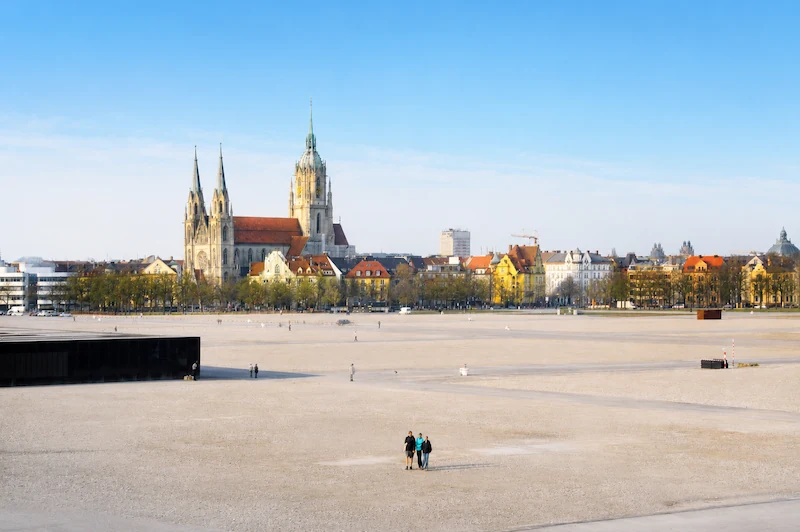
Ludwigsvorstadt-Isarvorstadt is the most practical Munich base for rail arrivals, Oktoberfest access and travelers looking for better value near the center. It is a mixed district, changing quickly from station streets to residential blocks, international restaurants, Sendlinger Tor, Gärtnerplatz edges and the Theresienwiese area. The experience depends heavily on the exact address, so this is where street-level hotel selection matters most. Stay here for function, price and access, not for Munich’s most polished atmosphere.
Why stay here: Stay here when logistics are central to the trip: Hauptbahnhof arrivals, early trains, Oktoberfest, budget pressure, concert or event access, or a short stay where transport access beats old-town charm.
Best for: Budget-conscious travelers, rail arrivals, Oktoberfest visitors, short practical stays, early departures and anyone prioritizing transport convenience.
Pros
Very practical for Hauptbahnhof, rail arrivals and onward travel.
Best area for Oktoberfest access around Theresienwiese.
Wider hotel range and more value than Altstadt-Lehel.
Good U-Bahn, S-Bahn and tram links across the city.
Strong international food options in some pockets.
Can work well for short stays when exact hotel location is chosen carefully.
Cons
Street atmosphere is uneven, especially near the station.
Less elegant than Altstadt-Lehel, Maxvorstadt, Schwabing or Haidhausen.
Some hotels feel more functional than memorable.
Not ideal for travelers who want a quiet, refined Munich base.
During Oktoberfest, prices can rise sharply despite the practical location.
Nearby highlights
Reach Munich Hauptbahnhof quickly for trains across Germany, Austria, Switzerland, and Italy.
Stay close to Theresienwiese during Oktoberfest without needing long transfers.
Walk into the old town from many addresses while paying less than prime central rates.
Use U-Bahn, S-Bahn, and tram links to reach outer sights efficiently.
Find more hotel availability when Altstadt-Lehel is expensive or sold out.
Access international restaurants and late-opening practical services.
Budget
Buddy Hotel – Compact self-service hotel near Karlsplatz and the station, useful for short, practical stays. Why we recommend: A strong budget option when central access matters more than room size. Check availability
B&B Hotel München-Hbf – Simple chain hotel near the main station and Theresienwiese, suited to budget and logistics-focused trips. Why we recommend: Good for travelers who want predictable basics close to transport. Check availability
Hotel Jedermann – Traditional budget-friendly hotel west of the station with access to Theresienwiese and transit. Why we recommend: A practical choice for Oktoberfest or rail-based stays without central luxury pricing. Check availability
Mid
Schiller5 Hotel – Comfortable aparthotel-style property near the station, useful for short stays needing space and convenience. Why we recommend: Better room practicality than many station-area hotels in the same band. Check availability
Marc München – Modern adults-focused hotel near Hauptbahnhof with clean rooms and easy central access. Why we recommend: A more polished station-area option than the surrounding budget-heavy choices. Check availability
Eurostars Book Hotel – Modern hotel near the main station, suited to travelers who want transport convenience and larger-hotel reliability. Why we recommend: Useful when you want a practical base without sacrificing too much room comfort. Check availability
Upscale
Sofitel Munich Bayerpost – Upscale hotel in a historic postal building beside the main station, with spacious rooms and strong facilities. Why we recommend: The strongest luxury choice for travelers who need Hauptbahnhof access without accepting a basic station hotel. Check availability
Le Méridien Munich – Large upscale hotel opposite the main station, suited to comfort-focused stays with easy rail access. Why we recommend: A dependable premium option when train logistics are central to the trip. Check availability
Roomers Munich, Autograph Collection – Design-led upscale hotel west of the station, with stronger atmosphere and facilities than typical transit hotels. Why we recommend: Best for travelers who want a more expressive hotel while staying near transport links. Check availability
Olympiapark
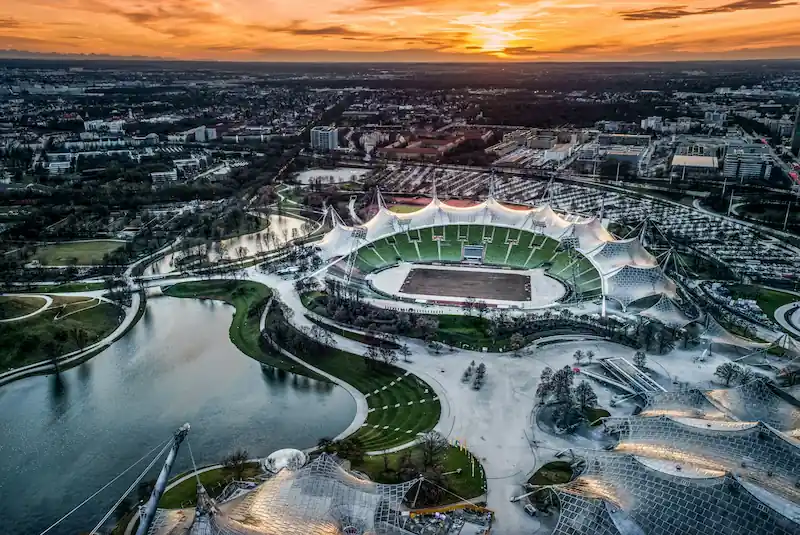
Olympiapark is not the best area to stay in Munich for most first-time visitors, but it is the right choice for specific trips. The district is built around modern Munich: Olympic architecture, broad green slopes, BMW Welt, BMW Museum, event venues, family attractions and the northern side of the city. It feels open and spatially different from the old town, with curved rooflines, wide paths and more sky than the historic center. Choose it deliberately for BMW, concerts, sports or family-attraction logic, not as a generic central base.
Why stay here: Stay here if your trip is tied to BMW, Olympiapark events, concerts, family attractions, northern Munich business logistics or modern architecture. Otherwise, it is better as a half-day visit than as a base.
Best for: BMW-focused trips, events, families, modern architecture, concerts, northern business stays and travelers who do not need to sleep in central Munich.
Pros
Best base for Olympiapark, BMW Welt, BMW Museum and Olympic Hall events.
Useful for families with specific attractions in the area.
More space and modern hotel stock than the old town.
Good for travelers attending concerts, sports or business events nearby.
Often better value than the most central districts outside major events.
Works well if you already know your itinerary is north-focused.
Cons
Too far from the old town for the easiest first-time sightseeing base.
Less evening atmosphere than central or residential inner neighborhoods.
Many stays feel functional rather than deeply local.
Requires regular transport for Marienplatz, the Residenz and old-town dining.
The Olympic Tower is closed for renovation, so do not choose the area just for that viewpoint.
Nearby highlights
Reach BMW Welt and BMW Museum without a cross-city journey.
Use Olympiapark for open space, viewpoints, family time, and event access.
Stay close to Olympic Hall and northern concert or sports venues.
Combine modern architecture, car culture, and green space in one cluster.
Avoid central hotel pricing during some non-festival periods.
Use transport links to reach the old town while sleeping in a quieter modern area.
Budget
B&B Hotel München-Olympiapark – Budget-friendly hotel near Olympiapark and the northern shopping and transport area. Why we recommend: A simple, useful choice when price and Olympic Park access matter most. Check availability
Motel One München-Olympia Gate – Reliable value hotel with easy access to Olympiapark and northern Munich. Why we recommend: Better designed than many budget choices near the Olympic Park cluster. Check availability
MEININGER Hotel München Olympiapark – Budget-oriented hotel suited to groups, families, and event visitors near Olympiapark. Why we recommend: A flexible option when low cost and simple access outweigh traditional hotel atmosphere. Check availability
Mid
Leonardo Royal Hotel Munich – Modern hotel north of Olympiapark with larger-hotel facilities and convenient transport. Why we recommend: Useful for event visitors who want more comfort than basic budget hotels. Check availability
H2 Hotel München Olympiapark – Modern hotel beside the Olympic Park transport cluster, built for practical stays. Why we recommend: One of the most convenient choices for Olympiapark and BMW-focused trips. Check availability
Holiday Inn Express Munich - Olympiapark – Straightforward modern hotel near the Olympic Park and northern business areas. Why we recommend: A sensible mid-range base when the trip is event-led or family-practical. Check availability
Upscale
Adina Apartment Hotel Munich – Apartment-style upscale hotel with larger rooms and practical facilities in modern Munich. Why we recommend: Good for longer stays that need more space and a contemporary hotel format. Check availability
Andaz Munich Schwabinger Tor – Premium contemporary hotel north of the center, with strong design and spacious rooms. Why we recommend: The best upscale choice if you want modern Munich rather than old-town luxury. Check availability
Munich Marriott Hotel – Large upscale hotel with reliable facilities and easy northern Munich access. Why we recommend: A strong practical choice for travelers who value comfort, amenities, and transport links. Check availability
Where to stay in Munich for a first visit
First-time visitors should usually prioritize location efficiency over chasing the quietest or cheapest district. Munich is manageable, but the main old-town sights, museums, parks and outer clusters separate quickly once the itinerary fills. A first stay works best when the hotel supports the first two days: old town, Residenz, Viktualienmarkt, one museum block and one outdoor pause.
Choose Altstadt-Lehel if you have two or three nights and want the least complicated Munich stay.
Choose Maxvorstadt if museums matter almost as much as Marienplatz and the old town.
Choose Glockenbachviertel if evenings, restaurants and a less formal atmosphere matter more than pure sightseeing efficiency.
Choose Haidhausen if you want a calmer first visit with good transport, family practicality and local restaurants.
Avoid Olympiapark as a first-time base unless BMW, events or family attractions are the main reason for the trip.
Avoid choosing only by hotel price near the main station without checking the exact street and transit links.
TravelerType
BestArea
Why
Classic first trip
Altstadt-Lehel
Maximum walkability and shortest distance to major landmarks.
Culture-first first trip
Maxvorstadt
Museums, old-town access and a calmer central rhythm.
Evening-led first trip
Glockenbachviertel
Better restaurants, bars and local evening texture while staying central-adjacent.
Quieter first trip
Haidhausen
Residential feel with fast transport back into the center.
Where to stay in Munich with family
Families usually benefit from calm streets, transport access, room practicality and easy outdoor breaks. Munich is family-friendly, but the wrong base can make each day feel more rigid than it needs to be. For children, the best areas are usually the ones that reduce transitions: a central base for short stays, or a calmer base near parks, the Isar, the Deutsches Museum or Olympiapark for longer trips.
Haidhausen is one of the best family bases because it is calmer, well connected, close to the Isar and practical for the Deutsches Museum.
Schwabing works well for families who want the English Garden nearby and more residential evenings.
Altstadt-Lehel is useful for short family stays where walking distance reduces daily effort.
Olympiapark is sensible if BMW Welt, Olympic Park, SEA LIFE, concerts or family attractions shape the trip.
Ludwigsvorstadt-Isarvorstadt can work for families on a budget, but only if the exact street and room setup are right.
Apartment-style hotels can matter more than neighborhood prestige on stays of four nights or more.
FamilyPriority
BestArea
TradeOff
Shortest sightseeing days
Altstadt-Lehel
Higher prices and busier streets.
Calm and transport
Haidhausen
Less instant landmark access.
Parks and space
Schwabing
More reliance on U-Bahn.
BMW and Olympiapark
Olympiapark
Not ideal for old-town sightseeing.
Budget with transport
Ludwigsvorstadt-Isarvorstadt
Street choice matters much more.
Where to stay in Munich for nightlife and restaurants
Munich is not a nightlife city in the Berlin sense, so the best stay strategy is about restaurants, bars, beer halls, beer gardens and easy evenings rather than club density. Location matters most after dinner, when short walks become more valuable and repeated U-Bahn rides weaken the experience.
Glockenbachviertel is the best area for bars, restaurants, wine bars and a more local evening scene.
Altstadt-Lehel is better for classic beer halls, traditional restaurants and first-time Munich atmosphere.
Ludwigsvorstadt-Isarvorstadt can work for late-night practicality, but the street choice matters.
Haidhausen suits quieter restaurant-focused evenings rather than nightlife-heavy stays.
Schwabing is better for relaxed cafés and local evenings than for late-night intensity.
Westend is useful to mention for restaurants and Oktoberfest-adjacent evenings, but it is better handled as a secondary search area than a main first-time base.
EveningStyle
BestArea
Caution
Bars and restaurants
Glockenbachviertel
Some streets can be noisy.
Classic beer halls
Altstadt-Lehel
More tourist-heavy.
Casual local dinners
Haidhausen
Quieter after dinner.
Oktoberfest-adjacent evenings
Ludwigsvorstadt-Isarvorstadt or Westend edge
Prices and noise can rise sharply.
Where to stay in Munich on a budget
Budget stays in Munich are mostly about accepting a trade-off: less old-town atmosphere, smaller rooms, more transport use or a more functional street. The key is not simply moving far out, but choosing a lower-cost base that still keeps the trip efficient. A cheap hotel that forces repeated transfers can be weaker value than a slightly more expensive central or well-connected stay.
Ludwigsvorstadt-Isarvorstadt usually gives the strongest budget-to-access balance, especially around the station and Theresienwiese.
Maxvorstadt can work well when you find a simple hotel near the museum district or station edge.
Olympiapark and northern Munich can reduce costs, but only make sense if your plans fit that geography.
Haidhausen offers calmer value when availability is good, though hotel choice is more limited.
Altstadt-Lehel is rarely the best budget area, but small central hotels can be worth it for very short stays.
Sendling and Westend can offer better-value stays, but they require careful transport checks and are better treated as secondary options.
BudgetGoal
BestArea
WatchOutFor
Cheapest central compromise
Ludwigsvorstadt-Isarvorstadt
Street-by-street variation near the station.
Culture and value
Maxvorstadt
Prices rise near premium museum-zone hotels.
Lower prices with modern hotels
Olympiapark
Too far out for short sightseeing stays.
Calmer value
Haidhausen
Less hotel choice and more dependence on transport.
Where to stay in Munich for couples
Couples usually need a different Munich base from families or pure first-timers: the hotel should keep daytime sightseeing easy but make dinner, drinks and slower evening walks feel natural. The best choices depend on whether the trip is romantic, cultural, food-led or quietly upscale.
Glockenbachviertel is the strongest choice for couples who want restaurants, bars, boutique hotels and a more contemporary Munich feel.
Altstadt-Lehel works best for first-time couples who want classic Munich, luxury hotels, Christmas markets or short walks after dinner.
Maxvorstadt is ideal for culture-led couples who want museums, cafés and calmer central streets.
Haidhausen suits couples who prefer quiet local restaurants and a softer residential atmosphere.
Schwabing works for couples on longer stays who want the English Garden, cafés and a calmer north-side base.
CoupleStyle
BestArea
TradeOff
Classic romantic first visit
Altstadt-Lehel
Higher prices and more visitors.
Restaurants and bars
Glockenbachviertel
Some streets can be noisy.
Museums and cafés
Maxvorstadt
Less evening intensity.
Quiet local stay
Haidhausen
Less instant landmark access.
Where to stay in Munich for Oktoberfest
Oktoberfest changes Munich’s hotel logic completely. Theresienwiese sits in Ludwigsvorstadt-Isarvorstadt, but accommodation pressure spreads across the whole city, so the best base is not always the closest hotel. You want easy U-Bahn or walking access, a street you are comfortable returning to late, and a booking made much earlier than a normal city break.
Ludwigsvorstadt-Isarvorstadt is the most practical area for walking or short transfers to Theresienwiese.
Altstadt-Lehel is better if you want classic sightseeing and Oktoberfest access in the same stay, with higher prices.
Westend is worth considering as a secondary Oktoberfest search area because it sits near Theresienwiese but is not a main first-time base.
Maxvorstadt can work if you want a calmer central base with good transport to the festival.
Avoid remote hotels without direct transit; late-night returns become the real friction.
Book months ahead, especially for weekends and groups.
OktoberfestPriority
BestArea
WatchOutFor
Walkable festival access
Ludwigsvorstadt-Isarvorstadt
Street atmosphere and noise vary.
Sightseeing plus festival
Altstadt-Lehel
Very high prices.
Secondary value search
Westend / Schwanthalerhöhe edge
Check transit and exact street.
Calmer central stay
Maxvorstadt
You will use transport to reach Theresienwiese.
Where to stay in Munich for luxury hotels
Luxury in Munich is strongest when location and mood match the trip. Old-town luxury gives landmark access and classic prestige; quieter upscale hotels work better when space, service and calm matter more than stepping directly into Marienplatz.
Altstadt-Lehel is the strongest luxury area for first-time visitors, classic hotels, landmark access and polished service.
Maxvorstadt and the Old Botanical Garden edge work well for upscale culture-led stays close to museums and the center.
Glockenbachviertel and nearby central-south addresses are better for boutique character than grand hotel tradition.
Schwabing offers modern upscale hotels with larger rooms and a less historic feel.
Haidhausen and eastern central addresses suit travelers who want quieter luxury away from the busiest old-town streets.
LuxuryStyle
BestArea
Why
Classic Munich luxury
Altstadt-Lehel
Most prestigious central addresses and strongest landmark access.
Culture and calm
Maxvorstadt / Old Botanical Garden edge
Museums, central access and less old-town pressure.
Contemporary upscale
Schwabing
Modern rooms, facilities and more space.
Boutique-led stay
Glockenbachviertel / central-south edge
Better for style and local evening texture.
Where to stay in Munich for business, trade fairs and events
Business trips in Munich depend on whether meetings are in the center, near the trade fair, around the airport, in the north, or tied to an event at Olympiapark. For visitors adding sightseeing, the best base usually balances direct transport with enough evening quality.
Altstadt-Lehel works for central meetings and premium stays where evening walkability matters.
Maxvorstadt is practical for central access with a calmer, more professional rhythm.
Ludwigsvorstadt-Isarvorstadt is useful for rail-heavy business travel and early departures.
Olympiapark or northern Schwabing can make sense for BMW, northern offices, concerts and Olympic Park events.
For Messe München or airport-heavy trips, prioritize transit and meeting location rather than sightseeing charm.
BusinessNeed
BestArea
WatchOutFor
Central meetings plus sightseeing
Altstadt-Lehel or Maxvorstadt
Higher rates during fairs.
Rail convenience
Ludwigsvorstadt-Isarvorstadt
Choose the exact street carefully.
BMW / northern Munich
Olympiapark or Schwabing
Less convenient for old-town evenings.
Trade fair or airport focus
Transit-led hotel choice
May not suit leisure sightseeing.
Where to stay in Munich for longer stays
For stays of five nights or more, Munich becomes less about being closest to Marienplatz and more about livability. Room size, grocery access, quieter streets, transport, cafés and outdoor space begin to matter as much as landmark proximity.
Haidhausen is one of the best longer-stay bases because it feels residential but remains well connected.
Schwabing works well if the English Garden, cafés and calmer evenings matter.
Maxvorstadt is strong for long culture-led stays with museums and university-side streets nearby.
Glockenbachviertel suits longer stays when restaurants and evening atmosphere are the priority.
Apartment-style hotels around Haidhausen, Schwabing, Olympiapark or station edges can be better than small old-town rooms.
Altstadt-Lehel is excellent for a short stay but can feel expensive and visitor-heavy over a full week.
LongStayPriority
BestArea
Why
Residential comfort
Haidhausen
Calm, connected and good for daily routines.
Green space
Schwabing
English Garden access and quieter streets.
Culture every day
Maxvorstadt
Museums, cafés and central access.
Restaurants and evenings
Glockenbachviertel
Better local evening rhythm.
Where to stay depending on your trip length
The shorter the stay, the more Munich rewards centrality. As the trip gets longer, calmer districts and more specialized bases become easier to justify because you have time to use transport without weakening the itinerary. The right answer changes sharply between a 2-night first visit, a family week, an Oktoberfest trip and a BMW-focused event stay.
Label
Stay
Avoid
Why
1 to 2 nights
Altstadt-Lehel or the best-located edge of Maxvorstadt.
Olympiapark, far northern hotels, remote budget stays or station-area choices selected only by price.
Short stays need instant access to the old town, not theoretical transport savings.
3 days
Altstadt-Lehel for ease, Maxvorstadt for culture, or Glockenbachviertel if evenings matter.
Bases that require a long first transfer before every sightseeing block.
Three days is enough to balance landmarks, museums and one neighborhood rhythm, but not enough for inefficient routing.
4 to 5 days
Maxvorstadt, Haidhausen, Schwabing or Glockenbachviertel become more attractive.
Paying old-town premiums if you no longer need every sight at your doorstep.
Longer stays benefit from comfort, quieter streets and better evening texture.
1 week
Haidhausen, Schwabing, Maxvorstadt or apartment-style hotels near strong transit.
Small central rooms chosen only for landmark proximity.
A week in Munich works better when the hotel supports daily living as much as sightseeing.
Oktoberfest trip
Ludwigsvorstadt-Isarvorstadt, Altstadt-Lehel, Maxvorstadt or a well-connected Westend edge booked early.
Late bookings far from transit or hotels chosen without checking event access.
Oktoberfest changes the whole accommodation market, so logistics matter as much as neighborhood charm.
Christmas market trip
Altstadt-Lehel for maximum convenience, Maxvorstadt for calmer central access, or Haidhausen for quieter evenings.
Remote hotels that require cold late-evening transfers after market visits.
Evening market traffic concentrates around the old town, so nearby hotels save energy.
Family trip
Haidhausen, Schwabing, Altstadt-Lehel for short stays, or Olympiapark if the itinerary is north-focused.
Tiny central rooms, noisy bar streets and inconvenient transit gaps.
Families need recovery space and outdoor access as much as sightseeing proximity.
BMW, events or family-attraction stay
Olympiapark or northern Schwabing.
Sleeping there if your real priority is old-town sightseeing.
This area is excellent for a specific purpose but inefficient as a general first-time Munich base.
Business or trade fair stay
Choose by meeting location and transit first: Altstadt-Lehel/Maxvorstadt for central meetings, Olympiapark/Schwabing for northern business, or dedicated transit hotels for Messe and airport priorities.
Choosing a charming district that turns every meeting into a transfer.
Munich business logistics can override leisure neighborhood logic.
How to choose the right hotel in Munich
Once you have chosen the area, the exact hotel still matters. Munich is safe and well organized, but the difference between a good stay and a frustrating one often comes down to street position, transport access, room practicality, event timing, airport or station needs and whether the hotel supports the daily rhythm of the trip.
Topic
WhatToDo
WhatToAvoid
WhyItMatters
Exact street over district name
Check the hotel’s immediate street, not just the neighborhood label.
Assuming every station-area, central or northern hotel feels equally pleasant.
Munich’s districts can change character quickly from one block to the next, especially near Hauptbahnhof and Theresienwiese.
Walkability for short stays
Pay more for Altstadt-Lehel or central Maxvorstadt if you only have two or three nights.
Saving slightly on a hotel that forces repeated transport for every main sight.
Location savings disappear quickly when a short itinerary becomes fragmented.
Transport for outer attractions
Choose a hotel near U-Bahn or S-Bahn access if Nymphenburg, Olympiapark, BMW Welt, Allianz Arena or the airport matter.
Assuming Munich’s outer sights are walkable extensions of the old town.
Several major attractions sit in separate clusters that reward direct transport.
Room size and stay length
Prioritize larger rooms or apartment-style hotels for stays of four nights or more.
Booking a tiny central room for a longer trip only because the address looks prestigious.
Munich is comfortable when the hotel supports recovery between full days.
Oktoberfest and event dates
Book much earlier than usual and accept that the best-located hotels may disappear first.
Waiting for last-minute value during major festivals, football dates, concerts or trade fairs.
Event pressure affects the entire city, not only the immediate event district.
Airport and rail logistics
Use Hauptbahnhof or strong S-Bahn/U-Bahn access if you have early trains, airport transfers or onward travel.
Choosing a charming but indirect district when luggage and timing dominate the stay.
Munich Airport and rail links are straightforward, but poor hotel placement can add friction at the worst moments.
Boutique versus classic hotels
Use boutique hotels in Glockenbachviertel, Maxvorstadt or central edges when atmosphere matters.
Choosing boutique style if you mainly need family space, station access or predictable facilities.
The right hotel type should support the trip’s rhythm, not just look appealing.
Quiet versus convenience
Choose Haidhausen, Schwabing or quieter side streets when sleep quality matters most.
Assuming the most central hotel is automatically the best hotel.
A calmer base can make a longer Munich stay feel more balanced.
Oktoberfest walking distance
For Oktoberfest, compare walking distance to Theresienwiese with late-night comfort and hotel quality.
Booking the closest available room without checking reviews, street context or transit alternatives.
The nearest option is not always the best option during festival dates.
Old town premium
Pay the Altstadt-Lehel premium when it saves real time on a short or winter stay.
Paying old-town prices for a week-long trip if you would benefit from more space elsewhere.
Centrality has the highest value when time, weather or mobility are constrained.
FAQ: where to stay in Munich
These answers focus on the accommodation decisions travelers make most often: the best area, first-time bases, family stays, budget choices, nightlife, safety, Oktoberfest, station access, luxury hotels, short stays and whether central Munich is worth the premium.
What is the best area to stay in Munich for first-time visitors?
Altstadt-Lehel is the best area for most first-time visitors because it puts Marienplatz, the Residenz, Viktualienmarkt, Frauenkirche, Hofgarten, Alter Peter and classic beer halls within easy walking distance. It is more expensive, but the time saved is valuable on a short trip.
Where should I stay in Munich for a 3-day trip?
For three days, stay in Altstadt-Lehel if convenience is the priority, Maxvorstadt if museums matter, or Glockenbachviertel if you want better evening atmosphere. Haidhausen can also work if you prefer calm and do not mind using transport.
What is the best neighborhood to stay in Munich with family?
Haidhausen and Schwabing are two of the best family areas because they are calmer, well connected and close to parks, the Isar or local restaurants. Altstadt-Lehel can also work well for short family stays because it reduces walking and transport friction.
Where should I stay in Munich for nightlife and restaurants?
Glockenbachviertel is the best area for bars, restaurants and a more local evening scene. Altstadt-Lehel is better for traditional beer halls and classic Munich atmosphere, while Haidhausen works for quieter restaurant-focused evenings.
Where should I stay in Munich on a budget?
Ludwigsvorstadt-Isarvorstadt usually offers the strongest mix of price, access and hotel choice, especially near the station and Theresienwiese. Maxvorstadt, Haidhausen, Olympiapark and northern Munich can also offer value, but the trade-off is either availability or more transport use.
Is it worth staying in Munich old town?
Yes, if it is your first visit, your stay is short, or you want to walk to the main sights. It is less necessary for longer stays, when Maxvorstadt, Haidhausen, Schwabing or Glockenbachviertel may give better value, calmer evenings or more local texture.
Is Altstadt-Lehel the same as Munich old town?
Altstadt-Lehel includes Munich’s historic core and the Lehel area beside it. For travelers, it usually means the most central sightseeing base around Marienplatz, the Residenz, Viktualienmarkt, Frauenkirche and Hofgarten.
Is the area near Munich Hauptbahnhof a good place to stay?
It can be practical, especially for rail arrivals, early departures, budget stays and Oktoberfest access. The area is uneven by street, so choose hotels carefully and do not assume every station-adjacent address gives the same experience.
What is the safest area to stay in Munich?
Munich is generally safe for visitors, and areas such as Altstadt-Lehel, Maxvorstadt, Schwabing, Haidhausen and many parts of Glockenbachviertel are comfortable choices. Standard caution is still useful around the main station, crowded events and late-night transport.
Should I stay near Olympiapark in Munich?
Stay near Olympiapark only if your trip is built around BMW Welt, BMW Museum, Olympic Park, concerts, events, family attractions or northern Munich business. For classic sightseeing, Altstadt-Lehel, Maxvorstadt, Haidhausen or Glockenbachviertel are usually better bases.
Where should I stay for Oktoberfest in Munich?
Ludwigsvorstadt-Isarvorstadt is the most practical area for Oktoberfest because it includes Theresienwiese and nearby station access. Altstadt-Lehel, Maxvorstadt and Westend edges can also work if they have good transit or walking access. Book much earlier than normal.
Is Westend a good area to stay in Munich?
Westend can be useful for Oktoberfest, value and a more local feel near Theresienwiese, but it is not a stronger all-purpose first-time base than Altstadt-Lehel, Maxvorstadt, Glockenbachviertel, Haidhausen or Schwabing. Treat it as a secondary search area.
Is Sendling a good area to stay in Munich?
Sendling can work for budget-conscious or longer stays if the hotel has strong U-Bahn access, but it is usually less convenient for first-time sightseeing. It is better as a secondary option than a primary recommendation for most visitors.
Is Nymphenburg a good area to stay in Munich?
Nymphenburg is attractive and calm, but it is usually better to visit as a palace-and-park half-day than to stay there on a first trip. Consider it only if you want a quiet residential stay and do not mind using transport regularly.
Where should couples stay in Munich?
Glockenbachviertel is best for couples who want restaurants, bars and boutique energy. Altstadt-Lehel is better for classic first-time romance and luxury hotels, while Maxvorstadt works well for culture-led couples and Haidhausen for quieter local evenings.
Where should I stay in Munich for museums?
Maxvorstadt is the best area for museums because it gives easy access to the Pinakotheken, Museum Brandhorst, Lenbachhaus, Glyptothek, Königsplatz and the NS-Dokumentationszentrum. It is also close enough to the old town for balanced sightseeing.
Where should I stay in Munich for the English Garden?
Schwabing is the best base for easy English Garden access. Altstadt-Lehel and Maxvorstadt can also work for the southern edge of the park, but Schwabing gives a more residential green-space rhythm.
Where should I stay in Munich for Christmas markets?
Altstadt-Lehel is the most convenient area for Christmas markets because Marienplatz and the old-town market streets are nearby. Maxvorstadt and Haidhausen can work if you want calmer evenings while still keeping the old town accessible.
Where should I stay in Munich for luxury hotels?
Altstadt-Lehel is the strongest luxury area for classic Munich hotels, landmark access and polished service. Maxvorstadt edges, Schwabing and selected eastern central hotels work better if you want calm, contemporary rooms or more space.
Where should I stay in Munich for one night?
For one night, choose Altstadt-Lehel if you want a quick sightseeing stay, or Ludwigsvorstadt-Isarvorstadt / Hauptbahnhof if rail logistics matter more. Avoid remote areas unless the stay is tied to a specific event or business location.
Where should I stay in Munich for a week?
For a week, Haidhausen, Schwabing, Maxvorstadt or apartment-style hotels near strong transit usually work better than a small old-town room. Longer stays benefit from calm streets, cafés, grocery access, transport and space.
Is Maxvorstadt a good area to stay in Munich?
Yes. Maxvorstadt is one of the best Munich areas for culture, museums, solo travelers and couples who want central access without sleeping in the busiest old-town streets. It is less lively at night than Glockenbachviertel.
Is Haidhausen a good area to stay in Munich?
Yes. Haidhausen is a strong choice for families, longer stays and travelers who want a calmer local base with restaurants, squares, Isar access and good transport. It is less instantly convenient than Altstadt-Lehel but often more livable.
Is Schwabing a good area to stay in Munich?
Yes. Schwabing is good for green space, longer stays, families and travelers who want a residential feel near the English Garden. It is less efficient for very short first visits focused on the old town.
Is Glockenbachviertel a good area to stay in Munich?
Yes. Glockenbachviertel is one of the best areas for restaurants, bars, boutique stays and a more contemporary Munich atmosphere. Some streets can be noisy, so exact hotel location matters.
Which Munich area is best without a car?
Altstadt-Lehel, Maxvorstadt, Glockenbachviertel, Haidhausen and Ludwigsvorstadt-Isarvorstadt are all good without a car because walking and public transport are strong. A car is more burden than benefit for most Munich city stays.
Do you need to stay near the airport in Munich?
Only stay near Munich Airport if you have a very early flight, late arrival, or airport business. For sightseeing, it is better to stay in the city and use the S-Bahn or airport transfer options.
Where should I stay if I arrive by train in Munich?
If you arrive by train, Ludwigsvorstadt-Isarvorstadt and the Hauptbahnhof edge are practical, while Maxvorstadt and Altstadt-Lehel may offer a better visitor experience with only a short transfer. Choose based on whether rail logistics or atmosphere matter more.
Where should I stay for Allianz Arena?
If Allianz Arena is the main event, northern Munich, Schwabing or Olympiapark-side hotels can reduce travel friction. For general sightseeing, stay more centrally and travel to the stadium only for the match or tour.
Where should I stay for BMW Welt and BMW Museum?
Olympiapark is the most convenient base for BMW Welt and BMW Museum, but it only makes sense if those attractions or events are central to your trip. Otherwise, visit them as a half-day from a more central area.
Which area has the best public transport in Munich?
Ludwigsvorstadt-Isarvorstadt and Hauptbahnhof are strongest for rail and citywide connections, while Altstadt-Lehel, Maxvorstadt, Haidhausen and Schwabing also work well if the hotel is near U-Bahn, S-Bahn or tram stops.
Where should I stay in Munich if I want a quiet neighborhood?
Haidhausen and Schwabing are the safest quiet-neighborhood choices for most visitors. Lehel side streets and some Maxvorstadt addresses can also be calm while staying central.
Where should I stay in Munich if I want restaurants nearby?
Glockenbachviertel is the strongest restaurant-led base, followed by Haidhausen, Maxvorstadt and parts of Schwabing. Altstadt-Lehel has many restaurants too, but the feel is more traditional and visitor-heavy.
Is Munich better for hotels or apartments?
Hotels work well for short stays, first visits and central sightseeing. Apartments or apartment-style hotels become more useful for families, longer stays, work trips and travelers who need more space than a central room can provide.
Which Munich area should I avoid for a first visit?
Avoid choosing remote northern, western or airport-area hotels for a classic first visit unless the price difference is substantial and transit is direct. Olympiapark, Sendling, Westend and Nymphenburg can work for specific reasons but are not the strongest default bases.
What is the overall best place to stay in Munich?
For most first-time visitors, Altstadt-Lehel is the overall best place to stay. For culture, choose Maxvorstadt; for evenings, choose Glockenbachviertel; for families and calm, choose Haidhausen or Schwabing; for Oktoberfest and rail logistics, choose Ludwigsvorstadt-Isarvorstadt.
Choose your Munich base by what should feel effortless each day, not by the neighborhood name alone.
Keep planning your Munich trip
Once you have chosen where to stay, use the main Munich travel guide, things-to-do guide and itinerary pages to shape the rest of the trip around your base: central sightseeing from Altstadt-Lehel, culture from Maxvorstadt, evenings from Glockenbachviertel, calmer family rhythm from Haidhausen or Schwabing, and specific event logic from Olympiapark or Ludwigsvorstadt-Isarvorstadt.
Turn the right neighborhood into the right itinerary
Once you know where to stay in Munich, the next step is structuring the rest of your trip around that base. Use the planner to build a route that fits your pace, priorities, and how you actually want your days to unfold.